Cognitive Absorption is not Cognitive Load. The difference matters.
TL;DR. Cognitive Load, as Skelton and Pais introduced it in 2019, tells you developer load is too high. It does not tell you what to do about it. Cognitive Absorption — originally a user state described in Agarwal and Karahanna's 2000 MIS Quarterly paper, extended here as a platform design discipline — asks the actionable question: what is the platform absorbing on behalf of its users? Three operational signals (flow state retention, context switch cost, paved road compliance under pressure) tell you whether your platform team is actually absorbing or just building surface area.
The most popular metric in platform engineering measures the symptom, not the cause.
Cognitive Load, as Skelton and Pais introduced it in Team Topologies (2019), tells you the load on developers is too high. It does not tell you why, or what to do about it. The metric is diagnostic. It surfaces a problem. It does not name the discipline that solves the problem.
I needed a concept that named the design intent, not the diagnostic. So I went outside platform engineering.
The 2000 paper that nobody in platform engineering reads
In 2000, Ritu Agarwal and Elena Karahanna published Cognitive Absorption and Beliefs About Information Technology Usage in MIS Quarterly. They defined Cognitive Absorption as a state of deep involvement with software. Five dimensions: temporal dissociation, focused immersion, heightened enjoyment, control, curiosity. The paper was a behavioral construct in information systems research. It described what users feel when software disappears and the work emerges.
For twenty six years the concept stayed inside academic IS research. It never crossed into platform engineering vocabulary because platform engineering was not yet a recognized discipline when the paper was published.
I extended it from a user state to a platform design discipline. That extended version lives in the Foundations Framework as the third pillar.
The conceptual move is simple to state and operationally consequential.
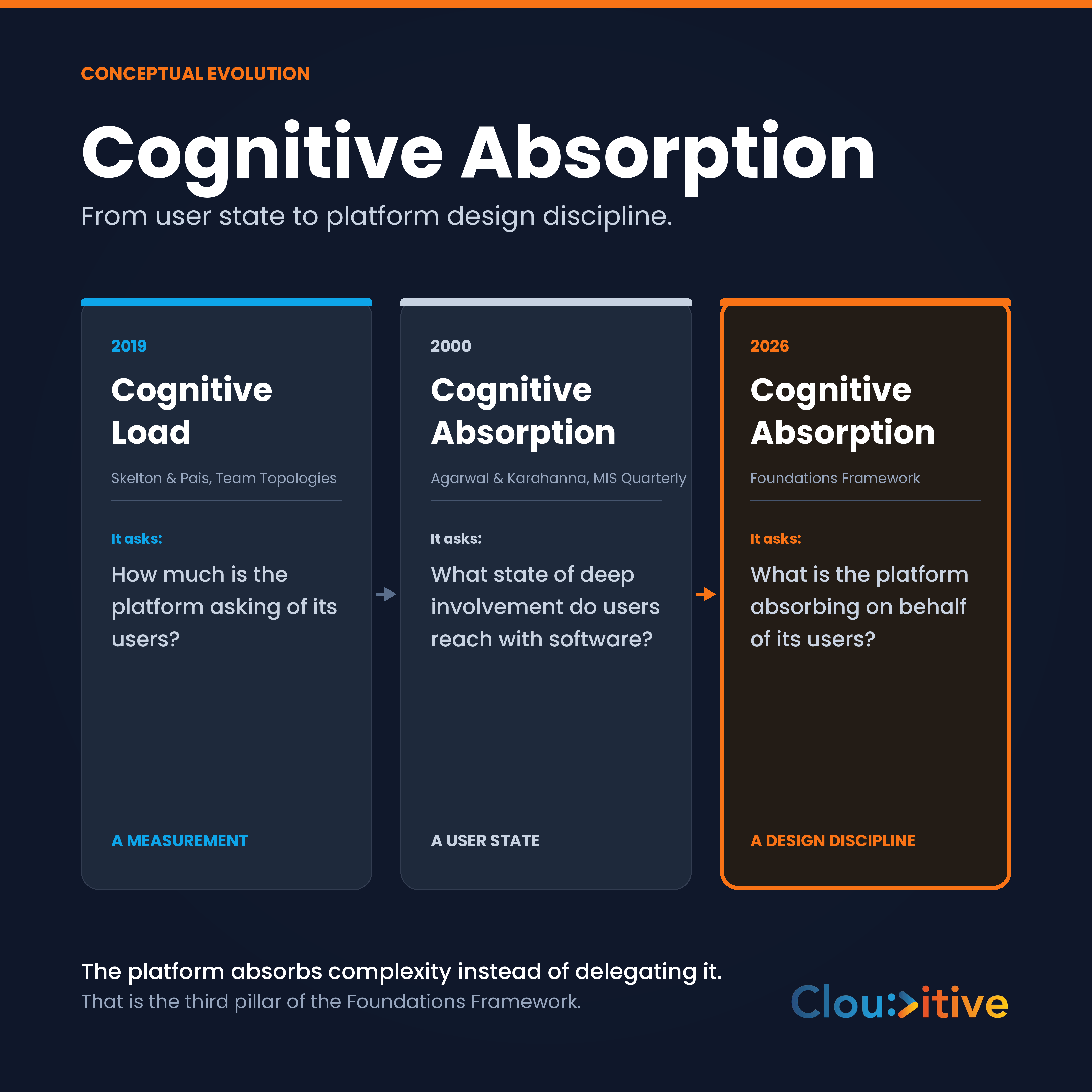
Cognitive Load asks one question. Cognitive Absorption asks a different one.
| Concept | Year | Origin | Question it answers |
|---|---|---|---|
| Cognitive Load | 2019 | Skelton and Pais, Team Topologies | How much is the platform asking of its users? |
| Cognitive Absorption (user state) | 2000 | Agarwal and Karahanna, MIS Quarterly | What state of deep involvement do users reach with software? |
| Cognitive Absorption (design discipline) | 2026 | Foundations Framework | What is the platform absorbing on behalf of its users? |
The first is a measurement. The second is a behavioral observation about the user. The third is a design intent for the platform team.
When you ask only the first question, you can detect the symptom. You cannot prescribe the cure. The platform team learns the developer is overloaded but not what work the platform should be doing instead.
When you ask the third question, the platform team has a clear mandate. Identify what the user is currently doing that the platform should be doing. Build that capability. Measure whether developers route through it.
This shift is not semantic. It changes what the platform team is accountable for.
Why "shift left" became "shift dump" — and how Cognitive Absorption names the correction
Shift left was a useful idea that became a damaging implementation. The intent was correct: catch issues earlier, when they are cheaper to fix. The implementation, in many organizations, dumped security, compliance, infrastructure, and operational concerns onto the developer's desk. The cognitive load that platform teams were supposed to absorb was instead delegated.
The METR 2025 study on AI in software development surfaced a parallel pattern. Senior developers using AI coding assistants in unfamiliar codebases were nineteen percent slower than baseline, even when they reported feeling faster. The AI offered help. The user had to evaluate, integrate, and verify. The cognitive cost moved from typing the code to validating the AI output. Net effect, slower delivery and lower quality.
In both cases, the same mechanism operates. Complexity that should be absorbed by an upstream system gets delegated downstream. The downstream worker reports satisfaction (the tool felt useful, the documentation existed) while the actual outcome degrades.
Cognitive Absorption names the correction. The platform absorbs complexity. The developer regains the time to do the work they were hired for.
Three operational signals that tell you whether your platform is absorbing or just present
Cognitive Absorption is operational. It needs measurable signals or it remains aspirational language. Three signals, used together, give the platform team a useful read.
1. Flow state retention
Time to first context switch under standard work.
When a developer starts a focused task, how long until they have to leave the task to chase something the platform should have provided. A failing local build that requires Slack triage. A missing credential. An unclear deployment path. Each context switch is a moment where the platform failed to absorb a concern.
Track it longitudinally. The number itself matters less than the trend. A platform investment that does not move flow state retention up over a quarter is not absorbing.
2. Context switch cost
Time to resume productive work after interruption.
Even when context switches are necessary (a real incident, a code review request from a colleague), the platform shapes how expensive the switch is. A developer with reliable bookmarks, fast local environments, and well structured documentation can return to flow in minutes. A developer working against fragile tooling can lose half a day re entering the problem.
This signal is sensitive to platform quality. It also surfaces toolchain rot before it becomes an outage.
3. Paved road compliance under pressure
Rate at which users default to the platform's preferred path when deadlines tighten.
This is the diagnostic. The paved road is the path the platform team built. It is the templated service, the golden CI pipeline, the standard deployment workflow. Under normal conditions, developers may follow it because it is convenient. The real test comes under pressure.
When the deadline tightens and the team is shipping fast, do they stay on the paved road or do they route around it?
If they route around, the platform is present but not absorbing. The shortcut they took was faster than the platform's preferred path. That is the data. It is not a developer failure. It is a platform design failure.
I have seen platforms that scored well on cognitive load surveys collapse on this metric. Developers liked the platform when there was time. They abandoned it when there was not. The platform was a peer, not an absorber.
What platform teams at high-absorption organizations do differently — observed patterns
The teams that have moved toward high Cognitive Absorption do not look like teams that followed a methodology document. They share operational behaviors that are recognizable across different company contexts.
They route interruption data into their backlog. Rather than treating developer context switches as background noise, these teams capture them systematically. When a developer opens a support ticket, asks a question in the platform Slack channel, or files a bug against the platform, the platform team classifies it: was this an avoidable interruption caused by a platform gap? If yes, the gap enters the backlog as a first-class item, not as a future roadmap consideration. The backlog is a live record of the ways the platform failed to absorb.
They test the paved road against their worst case, not their best case. Before declaring a golden path production-ready, these teams simulate the conditions under which it is most likely to fail: a developer who has never used it before, a deadline-driven deployment, a CI failure that requires diagnosis. If the path is not usable under those conditions, it does not launch. This is the design-for-pressure principle applied to platform release decisions.
They measure what developers do when the platform is unavailable. During planned maintenance windows or unplanned outages, these teams track what workarounds teams reach for. The workarounds are a direct read on which platform capabilities are genuinely absorbed into developer workflow and which ones are technically used but not trusted. A developer who continues work normally during a platform outage by routing to a manual workaround is a developer for whom the platform has not absorbed the relevant concern.
They staff platform on-call with customer success framing. The platform team's on-call rotation exists not primarily to fix platform failures but to surface the patterns in developer friction before they become systemic. The on-call engineer is the closest point of contact between platform design intent and developer operational reality. Teams that treat platform on-call as a maintenance burden rather than a signal source miss most of what the rotation could be telling them about absorption gaps.
These behaviors are not universal. They are concentrated in platform organizations that have explicitly adopted Cognitive Absorption as an accountability frame rather than as a theoretical reference. The difference in developer experience outcomes between teams that operate this way and teams that do not is measurable in the three signals described earlier in this post and in the cognitive load measurement work that pairs with this framework.
What a platform team that takes Cognitive Absorption seriously actually does differently
A platform team that takes Cognitive Absorption seriously will reorganize its work along three patterns.
Pattern one. Default path beats documented path. The team stops investing primarily in documentation and starts investing in defaults. Every new service, every new pipeline, every new database creation should arrive in a state that requires zero developer decisions to be production ready. Documentation supports edge cases. The default is the common case.
Pattern two. Failure mode design. The platform team treats every developer interruption as a design failure. A flaky test, a slow build, a missing environment variable. Each is logged, classified, and reduced or absorbed. The platform team is accountable for the second order effect, not just the first order capability.
Pattern three. Adversarial review of metrics. Quarterly, the platform team challenges its own measurements. Are the cognitive load scores honest, or are they artifacts of the survey instrument? Are the paved road compliance numbers true, or do they exclude the cases that matter most? This is the Signal Integrity pillar of the Foundations Framework, and it pairs with Cognitive Absorption. A platform team without adversarial measurement review will eventually believe its own dashboards.
What a high Cognitive Absorption platform looks like versus a low one — in practice
The contrast becomes concrete when you look at what developers actually do under the same conditions on platforms at opposite ends of the absorption spectrum.
A low absorption platform. A developer wants to deploy a new service. The golden path documentation exists and is reasonably current. The developer follows it, but the scaffold template requires manual configuration of four environment variables that are not documented in the template itself — they are in a Confluence page that was last updated eight months ago. The CI pipeline takes 22 minutes. Two of those minutes are spent on a flaky integration test that fails 30 percent of the time and requires a manual re-run. The developer knows this pattern and builds the re-run into their workflow, which means they have learned to expect failure as a normal part of the path. The deployment requires a Slack message to the platform channel to get a production approval from someone who is often in a different timezone.
Each step is documented. Each step works, eventually. The platform is present. It is not absorbing. The developer is absorbing every gap, every workaround, every piece of tribal knowledge that got embedded in the workflow rather than in the platform itself. The cognitive cost is not measured because it is invisible — it shows up as lead time, as engineer frustration scores, and eventually as turnover.
A high absorption platform. A developer runs a single scaffold command that creates a service with structured logging, distributed tracing, a health check endpoint, and a CI pipeline that completes in under 8 minutes. All environment configuration is injected automatically from the platform's configuration management system based on the service's declared dependencies. The flaky test was caught by the platform team's adversarial metrics review and replaced three months ago. The production deployment requires a passing test run and a code owner approval — both of which are gated in the pipeline, not in a Slack conversation.
The developer's cognitive engagement is directed at the product problem, not the operational machinery. This is what Agarwal and Karahanna were describing in 2000 when they wrote about temporal dissociation and focused immersion — the developer is absorbed in the work because the platform has absorbed the friction. The platform team achieved this not by writing better documentation but by making the correct behavior the default behavior.
The delta between these two scenarios is not primarily a function of budget or headcount. It is a function of where the platform team directs its attention. Teams that invest in defaults over documentation, and in failure mode design over feature additions, move toward the high absorption end of the spectrum. Teams that measure user satisfaction instead of paved road compliance under pressure often believe they are on the high absorption end when they are not.
Psychological safety and what it has to do with platform design
Amy Edmondson's 1999 paper "Psychological Safety and Learning Behavior in Work Teams" (Administrative Science Quarterly, vol. 44, no. 2) established that team members in psychologically safe environments were more likely to surface errors, ask questions, and propose changes. The connection to platform design is direct and underexplored.
A platform that surfaces unclear error messages, requires developers to ask Slack questions to complete routine tasks, or creates the expectation that "doing it wrong" will cause a production incident creates an operational environment that is the inverse of psychological safety. Developers who are uncertain about the correct deployment path will not necessarily ask. They will do what they have seen work before, or they will wait until a colleague who knows the system is available. Both behaviors produce delays. Neither surfaces the platform gap that caused them.
Edmondson's finding — that learning behavior is associated with psychological safety, not just team efficacy — applies to platform adoption directly. A platform that is clear about what to do when things go wrong, that provides useful error output rather than cryptic failure states, and that makes the cost of experimentation low produces a different developer behavior than one that does not. Developers who feel safe to try the platform's preferred path, fail visibly, and receive useful feedback will adopt the path faster and improve it more reliably than developers who avoid the path because failure is opaque.
This connection means that platform UX is not a secondary concern. The clarity of error messages, the usefulness of pipeline failure output, and the legibility of the deployment status page are not cosmetic. They are the environmental conditions that determine whether developers treat the platform as an absorber or as an obstacle. The platform that feels psychologically safe to use will be adopted. The one that does not will be bypassed the moment pressure appears.
For more on how the platform's measurement of its own absorption can become a vehicle for gaming rather than learning, read Signal Integrity in platform engineering — the second pillar of the Foundations Framework addresses exactly this risk.
How Cognitive Absorption relates to Cognitive Load — and why both matter
I respect the Team Topologies work. The Cognitive Load concept is necessary. It surfaces a problem that older platform engineering vocabulary missed. The point of Cognitive Absorption is not to replace Cognitive Load. The point is to name the discipline that responds to it.
In practice, I run both:
- Cognitive Load surveys quarterly to baseline developer experience.
- Cognitive Absorption signals continuously to track whether the platform is absorbing the load surfaced by the surveys.
The survey is the diagnostic. The three signals are the treatment effect.
When three teams each successfully shift left and the developer absorbs all three
Shift left worked when platform teams existed to absorb the shifted concerns. It failed when the shifted concerns landed on developers who had no upstream support.
The Foundations Framework treats this distinction as load bearing. We sequence Platform Foundation Build before any shift left initiative. Without the platform team operating as an absorber, every shift left effort is a delegation effort wearing a different hat.
I have walked into engineering organizations where the security team had successfully shifted scanning left, the compliance team had successfully shifted attestation left, and the operations team had successfully shifted on call left. The developer was the recipient of all three shifts. Predictably, deployment frequency dropped, change failure rate rose, and the senior engineers started leaving.
Cognitive Absorption is the corrective. The platform absorbs. The developer focuses. Velocity returns.
The diagnostic question I open every Foundations Assessment with
This is the question I open every Foundations Assessment with. The answers are diagnostic.
If the team routed around the deployment pipeline because the pipeline was slow, the platform did not absorb that concern. If the team copy pasted a Terraform module instead of using the standard one because the standard one had unclear documentation, the platform did not absorb. If the team added a manual cron job instead of using the scheduling capability the platform provides because the platform's version required three approvals, the platform did not absorb.
Each instance is a data point. The pattern across instances is the design failure that Cognitive Absorption names.
Cognitive Absorption as the third pillar of the Foundations Framework
Cognitive Absorption is the third of five pillars in the Foundations Framework, the proprietary platform engineering method that runs every Clouditive engagement. The first two pillars (Delivery Reliability and Signal Integrity) handle measurement honesty. The fourth and fifth (Security and Compliance by Default, Operational Accountability) handle distributed responsibility. The third pillar, Cognitive Absorption, is what the platform team owes its users.
It is the pillar that distinguishes a platform team from a tooling team. A tooling team builds tools. A platform team absorbs complexity.
How to run a two-week Cognitive Absorption audit with no new tooling
You do not need a six month measurement program to start. The first audit can run in two weeks with no new tooling. Here is the sequence I use in the Horizon phase of every Clouditive engagement.
Week one. Capture the routes around. Pick five recent sprints. For each sprint, ask each squad two questions in writing. What did you build that the platform should have provided. What did you skip from the platform because it slowed you down. The answers are the qualitative baseline. Do not aggregate yet, treat each instance as a primary source. Ten squads times two answers times five sprints is one hundred data points. Patterns emerge fast.
Week two. Instrument the three signals. Flow state retention is recoverable from existing telemetry. CI logs show how often a build fails locally and forces a context switch. Slack export shows interruption frequency in development hours. Context switch cost can be approximated by time between code editor focus events if your IDE telemetry is on. Paved road compliance under pressure is measurable from deployment metadata. For every production deployment in the last quarter, classify whether the path used was the canonical one or a custom variant. Build the ratio. Slice it by team and by sprint pressure level.
Week three. Triangulate against Cognitive Load survey. Run the standard Team Topologies cognitive load survey alongside the three signals. The interesting pattern is divergence. Teams reporting high cognitive load with high paved road compliance are signaling that the platform itself is too complex. Teams reporting low cognitive load with low paved road compliance are signaling that the platform is invisible, with developers operating outside it without complaint. Each pattern points to a different intervention.
Week four. Pick one absorption target. Resist the urge to fix everything. Pick the one place where developers most consistently route around the platform under pressure. Build the absorber. Measure the paved road compliance ratio for that path before and after. The first absorber sets the cultural expectation for the platform team. After three or four successful absorbers, the team has a discipline, not a backlog.
This sequence is the public version of what we run inside Horizon. The deeper rubric is reserved for engagement, but the pattern is reproducible by any platform team that decides to operate as an absorber.
Frequently asked questions
Is Cognitive Absorption a metric or a discipline?
Both. The 2000 user state version is a behavioral construct that can be measured directly with surveys. The 2026 design discipline version is operationalized through three signals (flow state retention, context switch cost, paved road compliance under pressure) that the platform team owns. The discipline is the platform team's accountability. The metrics are the feedback loop.
Does Cognitive Absorption replace Cognitive Load?
No. Cognitive Load is the diagnostic. Cognitive Absorption is the design intent that responds to it. Run both. The survey surfaces the problem. The three signals tell you whether your platform investment is fixing it.
Where does this concept live in published research?
The user state version comes from Agarwal and Karahanna 2000 in MIS Quarterly. The platform design discipline extension is original to the Foundations Framework, authored by Mat Caniglia at Clouditive. Both are credited explicitly when the framework is referenced.
Is the operating manual public?
The framework's principles, pillars, phases, and three persona platform user concept are public. The detailed operating manual, the rubrics, the cell by cell guidance, and the diagnostic instruments are reserved for clients in engagement. The first step into the method is the Foundations Assessment.
Read more
If you want to see how Cognitive Absorption sits inside a structured engagement model, read about the Foundations Framework or take the free Platform Score to baseline your own platform on the same five pillars Clouditive uses with clients.
If you are interested in the AI productivity adjacent research that influenced this work, read my analysis of the 2025 DORA report on AI and platform engineering and the discussion of measuring AI productivity in engineering teams.
References
- Agarwal, R., and Karahanna, E. (2000). Time flies when you're having fun: Cognitive absorption and beliefs about information technology usage. MIS Quarterly, 24(4), 665 to 694. https://www.jstor.org/stable/3250951
- Skelton, M., and Pais, M. (2019). Team Topologies: Organizing Business and Technology Teams for Fast Flow. IT Revolution Press.
- DORA. (2025). State of AI Assisted Software Development. https://dora.dev/dora-report-2025/
- METR. (2025). Measuring the impact of early 2025 AI on experienced open source developer productivity. https://metr.org/blog/2025-07-10-early-2025-ai-experienced-os-dev-study/

Mat Caniglia
LinkedInFounder of Clouditive. 18+ years transforming engineering organizations across LATAM and globally through Developer Experience consulting.
79 articles published