
Hire a forward deployed engineer when the problem lives inside your systems and you need someone who hears it and ships the fix in your environment. Hire a consultancy when you need an outside view, a recommendation or a defined deliverable more than daily hands on the keyboard. The deciding question is who should write the code that changes production: someone embedded with you, or a firm working from outside.
We sell forward deployed engineering by the hour, and we sell fixed-scope projects, which is the part of a consultancy’s work we do. We don’t sell managed services. I’d like you to hire us, so discount what follows accordingly.
What is a forward deployed engineer?
A forward deployed engineer (FDE) is a software engineer who works directly with a customer, inside their team and on their real systems. The job combines building (writing code, wiring integrations, deploying) with understanding the problem first-hand, in the customer’s meetings and repositories.
The point of hiring one is that the engineer who hears the problem is the one who fixes it. Nobody sits between the person who listens and the person who builds.
What does a consultancy do differently?
A consultancy sells expertise and an outcome from outside your team. The usual shape is an assessment, a set of recommendations and sometimes an implementation project, run by a team the firm assembles. Its own process decides who does what, and the people change as the project moves between phases.
That model has real strengths: breadth from many clients, a senior person who has seen your problem somewhere else, a deliverable you can hold the firm to. Its usual weakness is distance. The people who write the recommendations aren’t always the ones who implement them, and often neither is around when the change meets production.
How do the two compare?
| Aspect | Forward deployed engineer | Consultancy |
|---|---|---|
| Where the work happens | Inside your team, your repos, your cloud accounts | Mostly in the firm’s own process, with check-ins |
| Who directs day to day | You, with the engineer owning the problem | The firm’s project lead |
| Typical output | Working changes in your production | Assessment, roadmap or a defined project |
| Continuity | The same person over time | Teams change between phases |
| Pricing (ours) | Hourly by seniority | Fixed price per package, or a monthly architect |
When does an FDE fit better?
When the problem is in production. A customer integration that keeps breaking, a release process nobody trusts, an AI feature that works in the demo and fails on real data. Diagnosis and fix happen in the same place, and that’s where an embedded engineer earns the hourly rate.
It also fits when context is the expensive part. If explaining your systems takes three weeks, you want that investment to stay with one person who keeps using it. And you need to be able to give access and direction. An FDE works in your accounts with your identities, so someone on your side has to grant access, set priorities and review the work. If nobody can, you’ll get a lonely engineer, and that’s on the arrangement, not on the engineer.
At MPI, a portfolio-analytics SaaS platform, one Clouditive platform engineer works with an AI agent alongside MPI’s DevOps lead and about 8 of its engineers. The work happens in their repos and their pipelines, next to the people who build the product.
For a sense of cost: we bill FDE work at the same published rates as staff augmentation, Lead / Architect USD 55 to 60, Senior 45 to 50, Mid 35 to 40, Junior 30, and there is no separate FDE package. A Senior at 160 hours is USD 7,200 to 8,000 a month (45 × 160 to 50 × 160). A Lead is USD 8,800 to 9,600. Months with holidays have fewer hours, and you pay for hours worked.
When does a consultancy fit better?
When you need a decision before you need hands. Which platform, which cloud, which architecture. That’s a deliverable. It also fits when the work has a natural end (a pipeline gets built, a portal foundation gets set up, an audit gets written), and when you want price and date fixed up front, because paying for an outcome is easier to approve than an open hourly line.
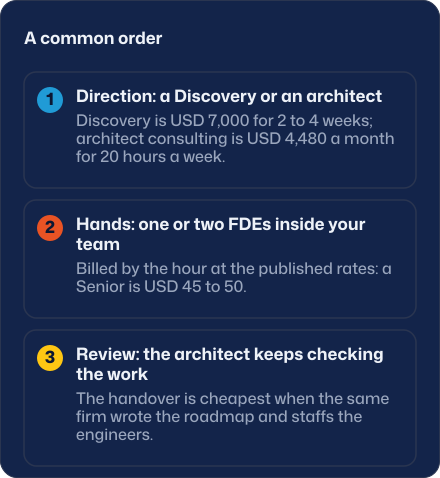
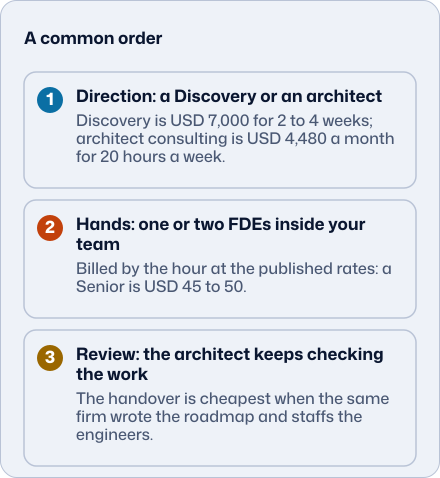
That’s the half of the consultancy model we sell as packages. Discovery is the closest to a classic engagement: USD 7,000 for 1 to 4 weeks, to understand the product and its configuration end to end and leave you a roadmap with backlog, roles, critical changes and needs. Architect consulting is USD 4,480 a month for 20 hours a week of an architect, covering design, consults, follow-ups and building architectures, without a full-time hire.
Can you combine them?
Yes, and it’s often the right order. A Discovery or an architect sets the direction, then one or two FDEs implement it inside your team. The handover is cheap when the same firm wrote the roadmap and staffs the engineers, and cheaper still when the architect keeps reviewing the FDE’s work.
The two also work together. MojoTrek, a US IT consultancy and Clouditive partner, uses our LATAM engineers to meet its own clients’ demand, across several projects and all our service areas. We are the engineers inside a consultancy’s delivery, because a good consultancy often needs embedded engineers to finish what it recommends.
What should I ask before hiring an FDE?
Get these answers in writing, from us or anyone else. Ours are in brackets.
- Who exactly will do the work, and can I interview them? (“A team” with no names is a staffing pool. With us, you interview the engineer who will do the work.)
- What happens if that person leaves? (We replace them and cover the handover at no cost.)
- In whose accounts, with which identities? (Yours, with SSO, MFA and least privilege, revoked at exit, after a background check before assignment.)
- Who owns the code? (You, from day 1, under an MSA and SOW. We sign an NDA before the call if you ask.)
- How many hours overlap with my team? (Ask for the range in your time zone, because “same working day” means nothing. Ours work between UTC-3 and UTC-5: at least 4 hours of overlap with US Eastern and 2 with US Pacific.)
We reply to a contact within 1 business day and present candidates within 1 week.
How is an FDE different from staff augmentation or a solutions engineer?
Staff augmentation adds an engineer to your team, under your direction, against your backlog. An FDE is engaged around a specific production or customer-facing problem and owns getting it working in that environment. Commercially ours are the same, since both come from the same hourly table.
A solutions engineer is another thing. They usually work in the sales cycle, showing how a product could fit. An FDE works after the decision, writing and deploying the code that makes it fit.
Write the problem as one sentence that names a system and a symptom. If you can, and the fix lives in your code, an FDE is the shorter path. If you can’t yet, start with a Discovery. The forward deployed engineering page has the definition, how we work and the rates by seniority, and the pricing page has the rest.