
A GovTech coordination portal, built from zero in 102 commits
One place for every request, change and approval that crosses teams, in government or business.
The engagement
Client: Arynvia (opens in a new tab)
- Status
- Built end to end by Clouditive
- Timeline
- Started 2026-09-25 · 102 commits in 12 days · First tag v0.1.0
What did Clouditive build for this coordination portal?
We designed and built all of it.
Every figure comes from the product's repository and its release pipeline.
Clouditive designed the product's 43 screens, with 114 approved frames, and built the whole product in 102 commits over 12 days. The portal runs on Next.js 16, React 19 and Postgres 18, split into 12 bounded contexts with enforced module boundaries and 9 migrations. Releases are cosign-signed images, deployed with no traffic, migrated by a Cloud Run job, health-checked and then promoted. A 9-page public site runs on a Cloudflare Worker.
43screens
43 screens designed in Figma at 1440 and 390 pixels, with 114 approved frames
102commits
102 commits in 12 days, from discovery to a tagged release
12bounded contexts
12 bounded contexts on Next.js 16, React 19 and Postgres 18, with module boundaries checked before code leaves the engineer's machine
Also on record
- Release pipeline: every release is a signed image that gets no traffic until its migrations ran and its health check passed
- Passwordless magic-link sign-in with an attempt cap, and Gmail delivery with no stored key
- 9-page public site on a Cloudflare Worker
What we did, by area
Areas of work
The product
One place for the work that crosses teams
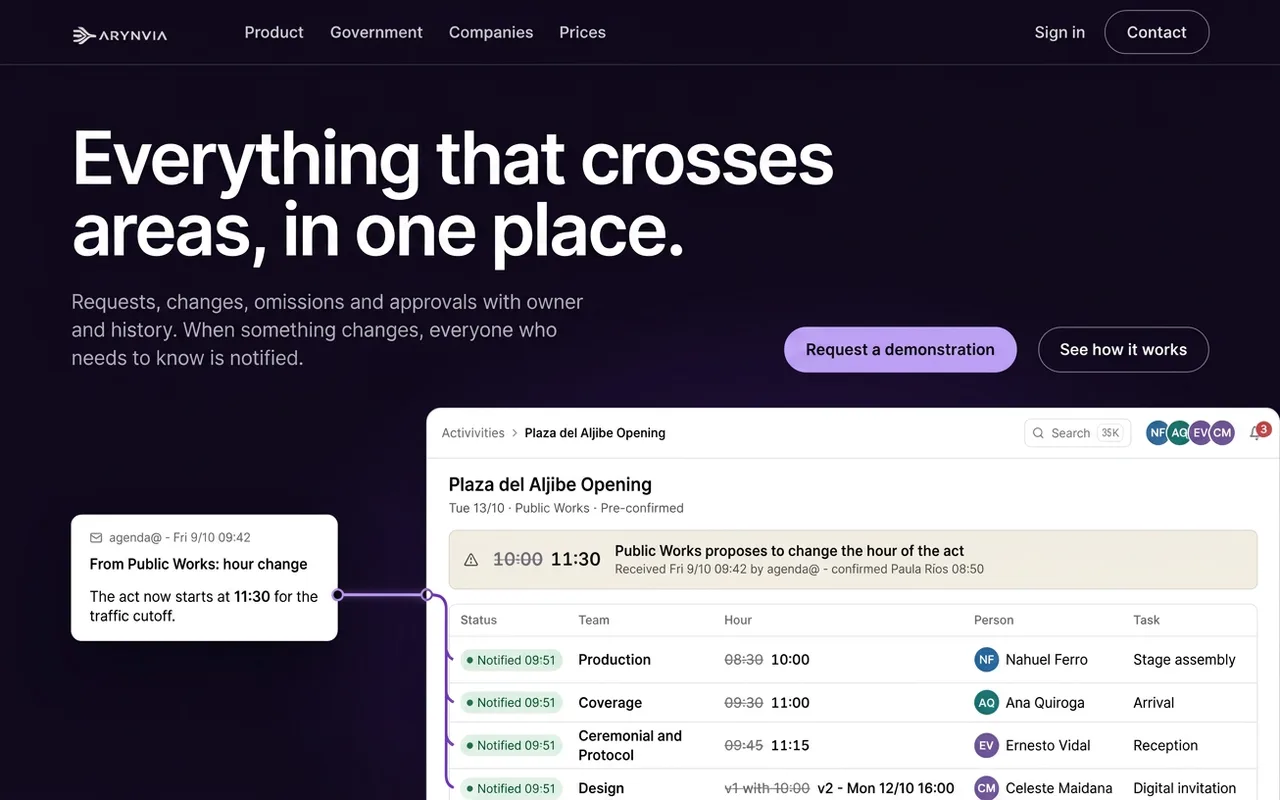
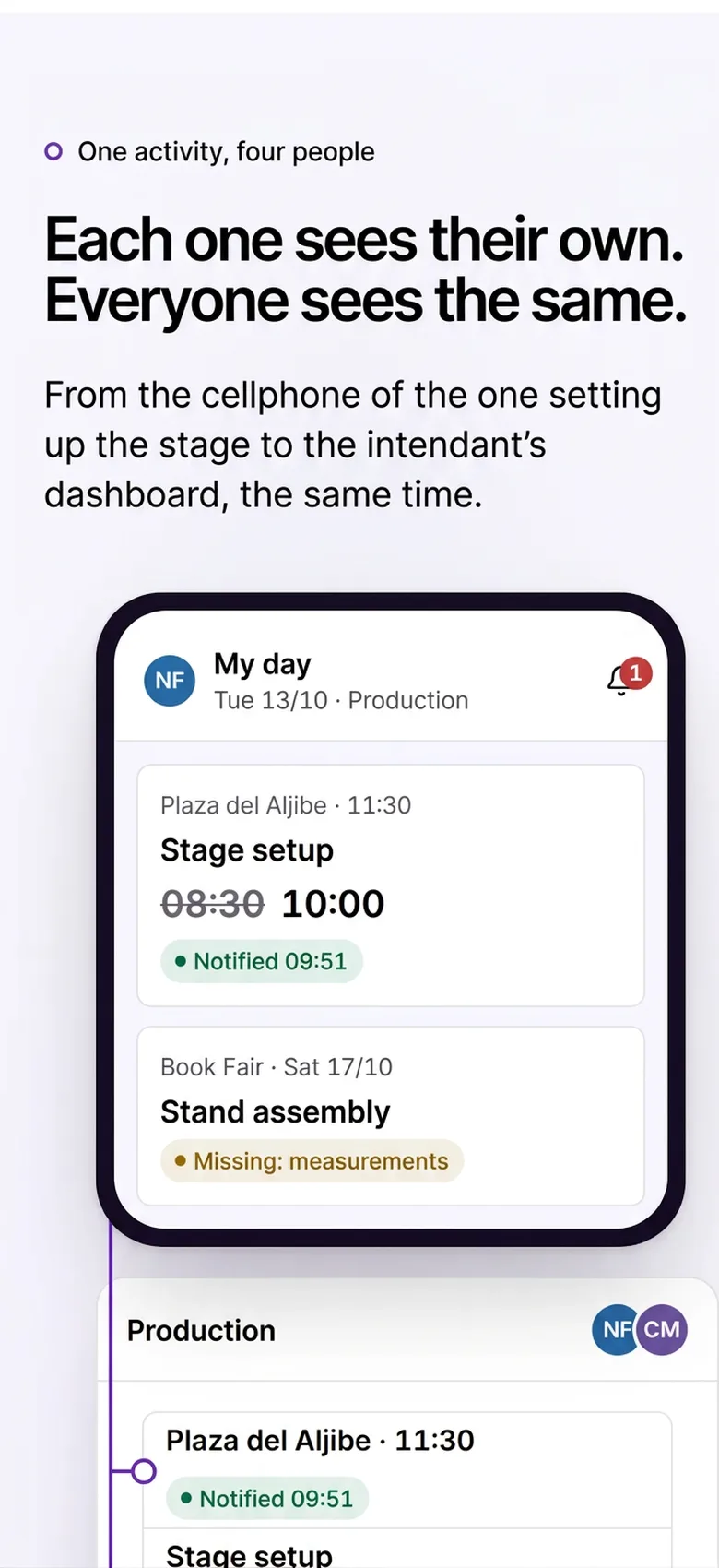
Staff log an activity step by step, and the portal tracks every missing item with an owner and a due date. When something changes, it computes who is affected, a person confirms the impact, and only then are those people notified. Each team sees the work that falls to it, and the history can't be edited.
People sign in with a magic link, no password. Cmd-K search finds any item, and a spreadsheet import brings existing work in. The design also covers an executive dashboard, a CRM, people, absences and budget, an editorial agenda, Drive and Calendar, and an AI copilot that suggests while a person confirms.
Two editions share one codebase: Gobierno for the public sector and Empresas for companies.
Product design and UX
43 screens and 114 frames, each approved before it was built
Discovery produced the full screen inventory for the public site and the portal. Each screen was designed in Figma at 1440 and 390 pixels and approved through a snapshot flow: 114 approved frames in all.
Architecture and backend
A modular monolith with 12 bounded contexts
Next.js 16 and React 19 on Postgres 18. Module boundaries are enforced in the push gate, so one context can't reach into another. The schema moves through 9 migrations, and the history table is immutable.
- Organizations and identity
- Mail and history
- Activities and missing items
- Changes and notices
- Work and requests
- Search and import
Identity and security
Passwordless sign-in and mail with no stored key
Sign-in is a magic link with a cap on attempts. Gmail delivery uses domain-wide delegation, so no mail key is stored. Every release image is signed with cosign before it can deploy.
CI/CD and release
Every release signed, health-checked, then switched on
A push gate checks secrets, types, lint and build before code leaves the machine. A release builds a cosign-signed image, deploys it by image digest (the fingerprint of that exact build) with no traffic, runs migrations as a Cloud Run job, checks health and then promotes the revision. The first tag is v0.1.0.
Web and QA
A 9-page site on Cloudflare, clicked through in a real browser
The public site is Astro with Tailwind v4 on the product's own token contract, served from a Cloudflare Worker, with DNS and the route in Terraform.
Playwright clicks through it with axe on WCAG 2.2 AA tags at 1440 and 390 pixels: 10 steps, 0 failed requests, 0 console errors and 0 axe violations on the pages judged.
Stack
Services used
The services behind this work.
In the client's words
Clouditive took our product from discovery to a working platform: 43 screens, 12 bounded contexts, passwordless sign-in and signed releases that run the exact tested build. We approved each screen in Figma and then saw it built, 102 commits in 12 days.
 GovTech & enterprise coordinationCTO
Published with the client's approval.
Frequently asked questions
What does the portal do?
A platform that puts the requests, changes, missing items and approvals that cross an organization's teams in one place, each with an owner and a history, and tells the right people when something changes.
What did Clouditive build?
All of it: discovery, 43 screens with 114 approved frames, the portal with 12 bounded contexts, the 9-page public site, passwordless sign-in, the signed release pipeline and the browser QA.
Which editions does the portal have?
Two editions on one codebase: Gobierno for the public sector and Empresas for companies.
How does the portal handle a change?
It computes who the change affects, a person confirms that impact, and only then are those people notified. Every step stays in an immutable history.
How do people sign in?
With a magic link, no password, and a cap on attempts.
How are releases shipped?
Each release is a cosign-signed image, deployed with no traffic, migrated by a Cloud Run job, health-checked and then promoted by revision.
Which stack does the portal use?
Next.js 16, React 19, Postgres 18, Cloud Run, cosign, Astro, Tailwind v4, Cloudflare Workers, Terraform, Figma, and Playwright with axe.
How long did the build take?
102 commits over 12 days, starting on 2026-09-25.
Tell us your case.
We reply to every request within 1 business day. We sign an NDA before the call if you ask.