
What is DevOps? The plain answer, then what to check
DevOps means the people who build the software also answer for how it ships and runs.

In short
DevOps is the practice of having the people who build software also answer for how it is released and how it runs in production, with automation doing the repeated work. AWS defines it as “the combination of cultural philosophies, practices, and tools that increases an organization’s ability to deliver applications and services at high velocity.” If you are not an engineer, read it this way: one team owns a change from the first commit to the moment a customer uses it, and a failed release is that team’s problem, not a hand-off.
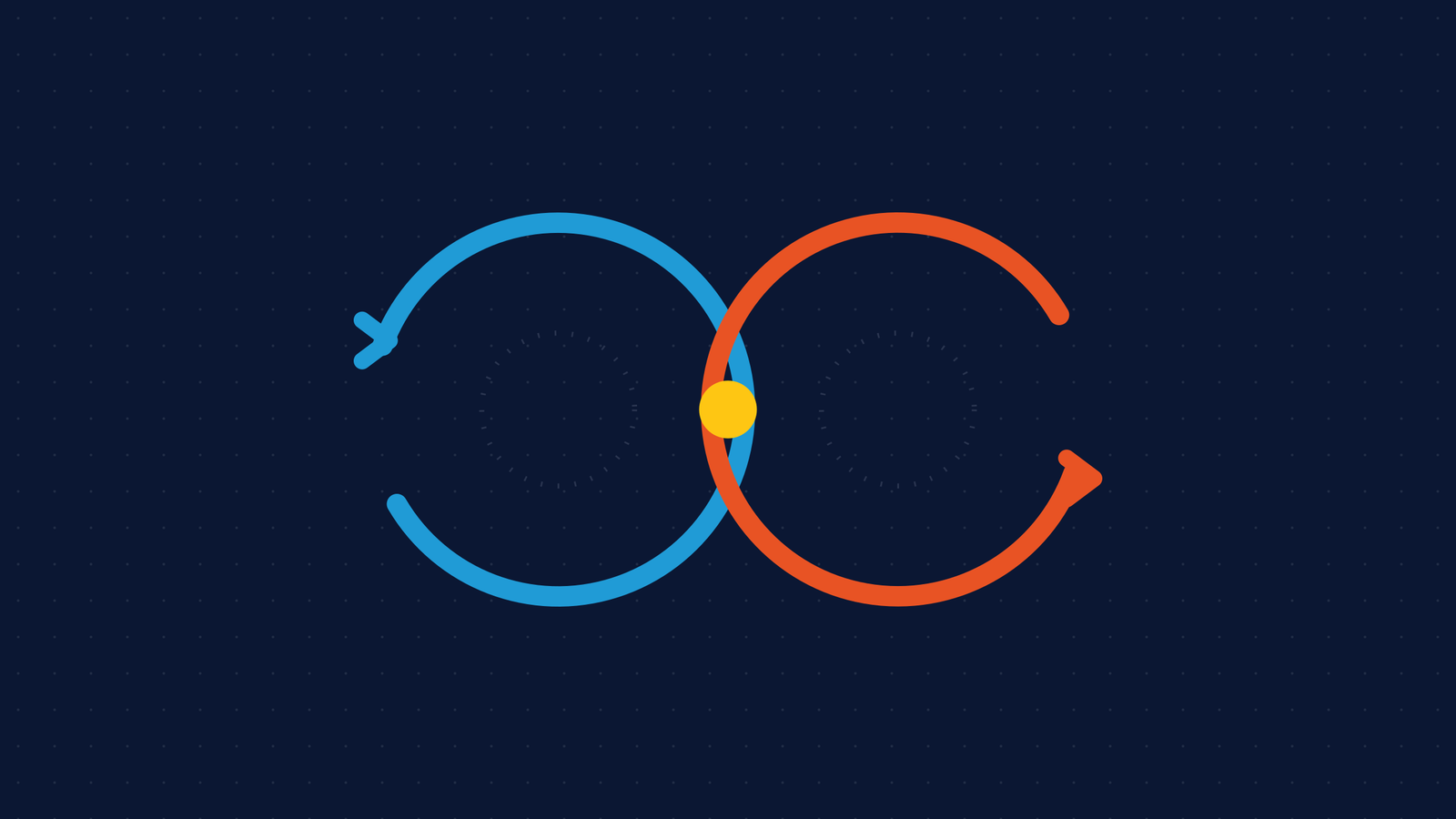
What is DevOps made of?
AWS lists six practices: continuous integration, continuous delivery, microservices, infrastructure as code, monitoring and logging, and communication and collaboration. We use four checks that a buyer can run, and each one answers a plain question. Rollback is our addition, not AWS’s. How we do it is on our DevOps consulting services page.
| Practice | The question it answers | What you can ask to see |
|---|---|---|
| Continuous integration and delivery | Can we release a small change safely, today? | A release the pipeline stopped |
| Infrastructure as code | Who approved the last change to our servers? | The plan of a change, read before it applied |
| Monitoring and logging | Do we find out before the customer does? | An alert that fired, and the record of what happened next |
| Rollback | How fast can we undo a bad release? | A rollback time, and the environment it was measured in |
A team can have a “DevOps engineer” and still hand every release to one person who remembers the steps. One engineer on r/sre described the other failure: “management says ‘we are DevOps, so it’s totally okay we only have 2 people to handle Infrastructure, Security, DBA, BuildRelease, Oncall, and everything else’” (r/sre, 2022-02-16).
How do engineers measure DevOps?
With five software delivery metrics from DORA, the research program that Google Cloud runs. DORA splits them into throughput and instability.
Throughput has three metrics. Change lead time is how long a change takes from commit to production. Deployment frequency is how often you ship. Failed deployment recovery time is how long you take to fix a failed release.
Instability has two. Change fail rate is the share of releases that need a rollback or a hotfix. Deployment rework rate is the share of releases forced by a production incident.
Those are DORA’s own definitions. DORA says they work for any application or service, whatever the technology stack. Our DORA metrics post shows how to read them from your own pipeline.
What changed at a client when the practices went in?
On a portfolio-analytics SaaS platform we run the release pipeline with the client’s own engineers. Production releases went from 1.15 a week (April to July 2026) to between 3.7 and 4.0 a week over the 30 days to early October 2026, as our Kubernetes and Argo CD page reports. Failed production releases went from 23% (77 of 334 before) to 4% (1 of 25 since July 2026), per our fintech page.
Read those numbers with their limits. The work was shared: one Clouditive platform engineer working with an AI agent, the client’s DevOps lead and about 8 of the client’s engineers, as the fintech page says. The rollback was rehearsed in dev only, and we publish no production rollback time (Kubernetes and Argo CD page).
Should you hire a person or buy a package?
It depends on whether you can write the finish line on one page. “Every push runs secrets detection, types, lint and build, and a version tag deploys by image digest” is an acceptance criterion. “Improve our DevOps” is not.
With a written criterion, our CI/CD & IaC package builds or redesigns the pipeline and the infrastructure as code for USD 4,000 fixed, in 2 weeks. Without one, or for continuous work, you hire engineer hours: a Senior is USD 45 to 50 an hour, or USD 7,200 to 8,000 a month at 160 hours, with a 6-month minimum. You interview the person who will do the work.
In our view, a small team with one application on a managed platform rarely needs a full-time DevOps role. It needs a gate that runs on the engineer’s machine before the push, and releases that go out by tag. You need a dedicated person once releases scare people, take days, or depend on one person’s memory.
What should you do first?
Ask your team to show you one release your pipeline stopped. If there is none, you know where to start. How we do it is on the DevOps consulting services page, and the difference from SRE and platform engineering is in SRE vs DevOps vs platform engineering.
Sources
- AWS, “What is DevOps?”: the definition and the practices.
- DORA, “DORA’s software delivery performance metrics”: the five metrics and their definitions.
- r/sre, “We’ve spent months building this platform”, quote from 2022.
- Release counts and failure rates: our own measurement, on our Kubernetes and Argo CD and fintech pages. Rates and packages: pricing.
New posts by email
Notes on rates, platform engineering, DevOps, SRE, QA and AI engineering, with the prices and figures from our own work.
Check your inbox
Tell us what you need. We reply in 1 business day.
We sign an NDA before the call if you ask.
