What does AI marketing software need to get right?

AI marketing software has to answer three questions before anything is published: is the piece allowed in this industry and country, is it good enough, and who approved it. Clouditive built a platform that answers them inside the product: forbidden-claims rules, an independent panel of AI judges that only blocks, and a person who approves every piece.

The platform works as a single marketing brain. It diagnoses a client's brand, sets objectives, plans campaigns, generates copy, images, carousels, documents and short videos with voice, and schedules them on the client's social networks.

Every figure on this page comes from the product's release history, its test runs and its repository. None comes from a client's campaigns.

What you get, step by step

Everything in the package, in the order it lands. The price and the duration stay the same.

  1. Step 1: The agent

    One AI agent working on one real use case of yours.

  2. Step 2: The evals

    Evals that score its output on that use case.

  3. Step 3: The cost

    Cost per task, measured.

  4. 2 weeks

    USD 5,000

Want to keep going after the package? Add engineers by the hour at the published rates, with a 6-month minimum term. How staff augmentation works.

Proven on real work

Real clients, dated figures, and a plain note on what was not done.

What did we build for an AI marketing platform?

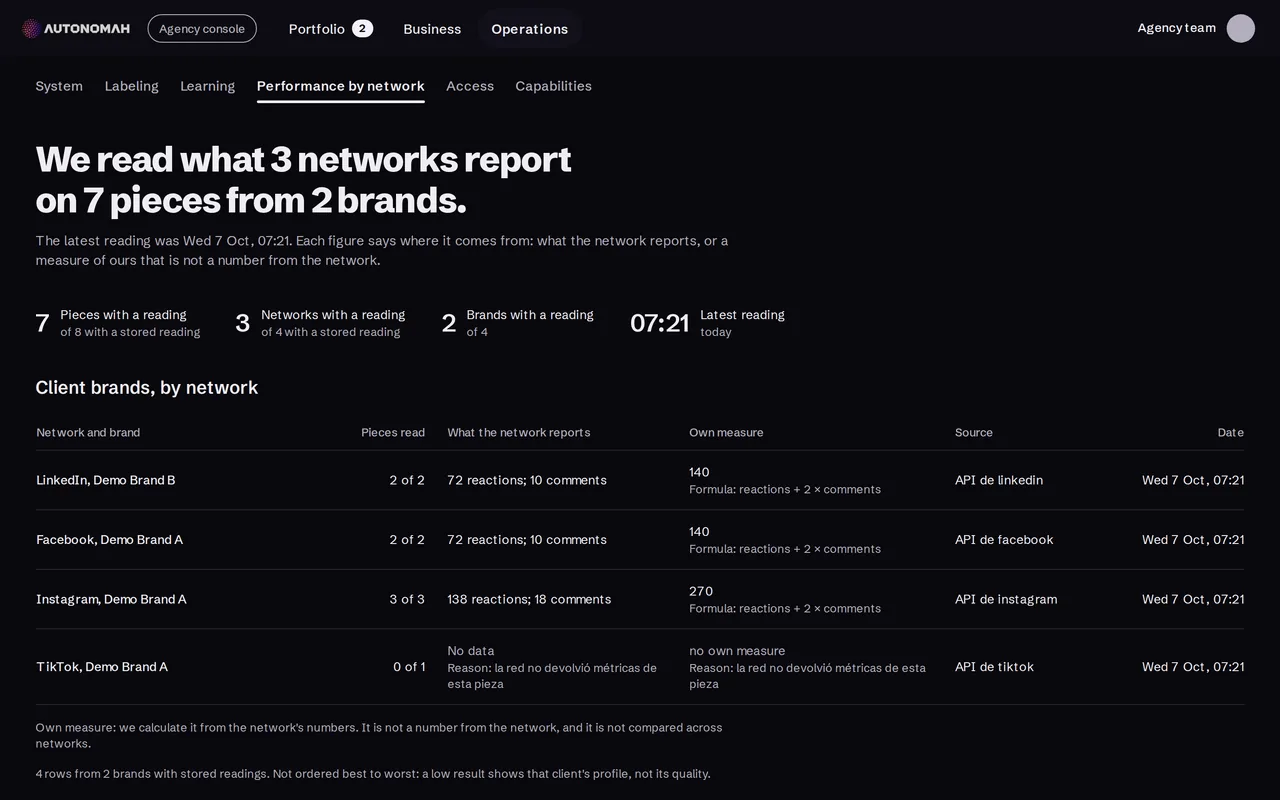
Performance by network in the agency console: what 3 networks report on 7 pieces from 2 brands, with the source of each figure. (interface shown in English)

Clouditive designed and built the whole platform: 6,031 commits in 28 days, then 89 releases in 10 days.

  • 16 bounded contexts, from the brain and generation to brand, calendar, reports and costs, with 53 pages and 90 API routes.
  • Gemini and open models on Vertex AI, plus text-to-speech and image models, with no single vendor.
  • A client portal for reports and pieces, and an admin console to run the service.
  • A weekly batch where each piece is approved on its own, and every edit feeds what the system learns.
  • Google Cloud in OpenTofu: a Cloud Run service, 9 jobs and 18 schedulers behind Cloud Armor.
  • A cost ledger for every piece and every model call.

Prefer to pay by the hour?

Add engineers to your own team at the published rates instead of buying a package.

  • You interviewYou meet the engineer who will do the work.
  • 6-month minimumBilled per hour worked.
  • Free replacementIf they leave or don't fit, we replace them and cover the handover at no cost.
See how staff augmentation works
  • Lead / ArchitectUSD55–⁠60per hour
  • SeniorUSD45–⁠50per hour
  • MidUSD35–⁠40per hour
  • JuniorUSD30per hour

USD per hour, drawn to one scale

Frequently asked questions

What does an AI marketing platform do?

The one in this case diagnoses a brand, plans its calendar, generates copy, images, carousels and short videos, and schedules them on social networks, with a person approving every piece.

Does the AI publish without a person approving?

No. Approval stays with a person. The judge panel only blocks verifiable defects and never approves a piece.

Which AI models does it use?

Gemini and open models on Vertex AI, plus text-to-speech and image models, with no single vendor. Cost per approved piece decides which model a station uses.

How does it avoid forbidden claims?

Forbidden-claims rules per industry and country, built from 438 data files from primary sources. 10 forbidden prompts produced 0 pieces.

Forbidden-claims rules by industry and country stop a piece before it exists. They are built from 438 data files from primary sources, and 10 forbidden prompts produced 0 pieces. A craft knowledge base per industry, niche and country covers 39 countries of the Americas, with a source and a quote for every principle. A person still approves what gets published.

That is a test result on forbidden prompts, not a promise about every piece a client generates.

Can you build the whole platform, not only the AI?

Yes. For this client we did product design, 16 bounded contexts, the AI with its judge panel, the Google Cloud platform in OpenTofu, the release pipeline, observability and the QA suites.

How fast did it ship?

6,031 commits in 28 days, and 89 releases in the 10 days after v1.0.0, every production deploy checked to run the exact tested build.

Who owns the code?

You do. All code and intellectual property are yours from day 1, under an MSA and SOW, with an NDA before the first call if you ask.

How much does it cost?

The AI Agent Pilot is USD 5,000 for 2 weeks at a fixed price. Hourly rates are USD 30–⁠60 by seniority and are on the pricing page.

Start with the AI Agent Pilot: USD 5,000, fixed price, 2 weeks. One AI agent works on one real use case of yours, with evals that score its output and the cost per task measured. Longer work runs by project or by hour: USD 30–⁠60 by seniority, with a 6-month minimum for staff augmentation.

One client's case is not a promise; the pilot is how we measure yours.

How do you judge and price AI output?

An independent panel of AI judges blocks verifiable defects and never approves; approval stays with a person. Each judge was tested on labelled examples, cases whose right answer is known, before it went into service, and calibration tools tune it against people's ratings.

Cost per approved piece decides which model each station uses, and a ledger records the cost of every piece and every model call.

How was the platform released and checked?

A release tag builds 3 images, runs the migrations, deploys by image digest and reads back the digest that is actually live. That ran 89 times in 10 days, from v1.0.0 to v1.61.0.

854 test files cover the product. Portal routes were checked with axe at 0 violations in light, dark, forced colours and zoom. Checked, not certified.

Tell us your case.

We reply to every request within 1 business day. We sign an NDA before the call if you ask.