
An AI marketing platform, built from zero in 28 days
An AI advertising service where a person approves every piece. We designed and built all of it.
What did Clouditive build, and how fast?
Every figure comes from the product's release history, its test runs and its repository.
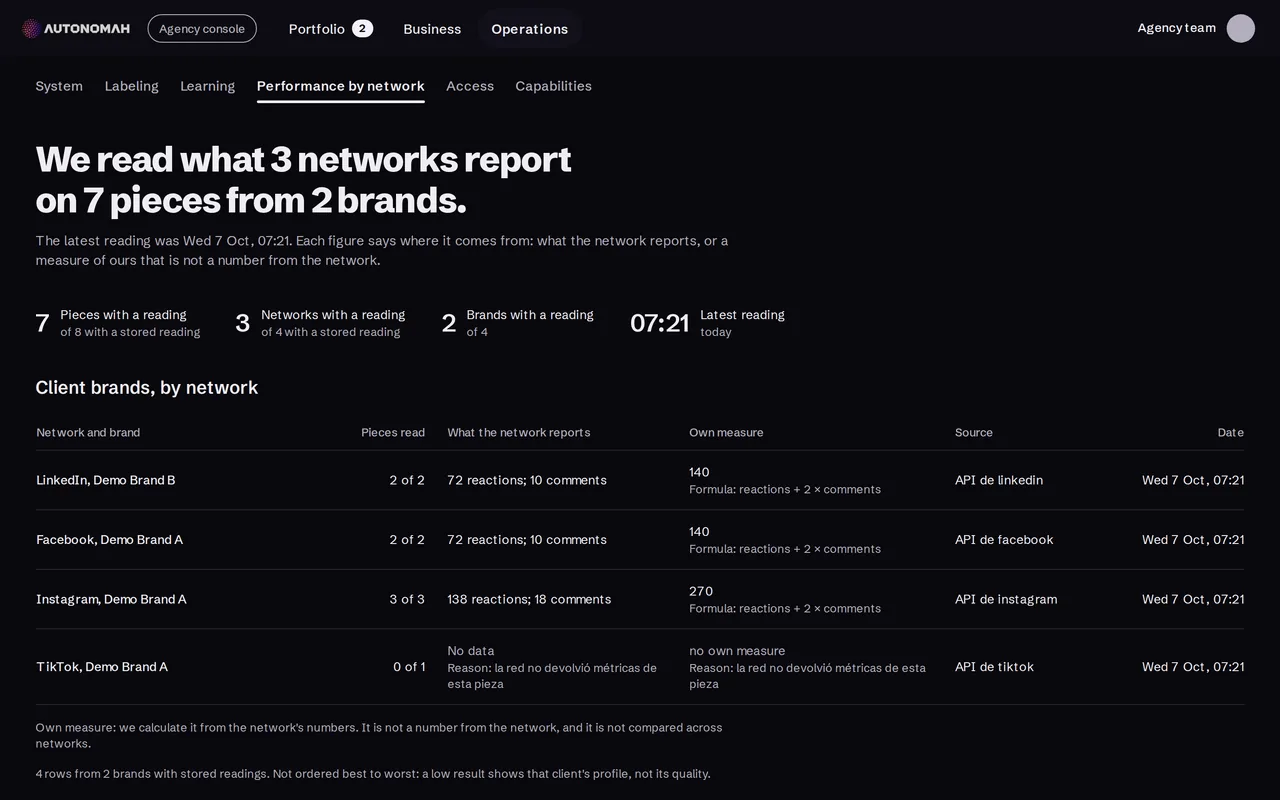
Clouditive designed and built the whole platform: the AI with its judge panel, the Google Cloud platform in OpenTofu, tag-driven releases that deploy by image digest, and the unit, integration and browser test suites. It took 6,031 commits in 28 days, then 89 releases in 10 days. A person still approves every piece the product publishes.
89releases
89 releases in 10 days, v1.0.0 to v1.61.0, every production deploy checked to run the exact tested build
30,282unit tests
30,282 unit tests (569 suites) and 1,440 integration tests (266 suites) passing at v1.61.0
1,440integration tests
0axe violations
Portal routes checked with axe at 0 violations in light, dark, forced-colours and zoom
Also on record
- 6,031 commits in 28 days, from the first commit on 2026-09-08
- 16 bounded contexts, 217 migrations, 53 pages and 90 API routes
- 10 forbidden prompts produced 0 pieces, against 438 forbidden-claims data files from primary sources
- Cloud Run service, 9 jobs and 18 schedulers behind Cloud Armor, with 18 alert policies and 43 mocked-provider IaC tests
- 854 test files
Dates
- First commit 2026-09-08
- v1.0.0 2026-09-26
- v1.61.0 2026-10-06
- latest v1.62.3
What we did, by area
Areas of work
The product
From brand diagnosis to an approved, scheduled post
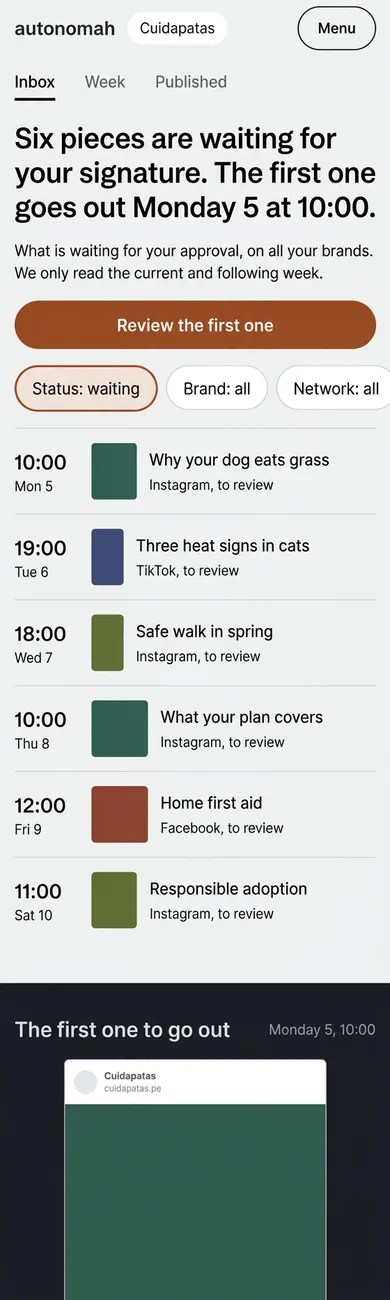
A client onboards in a single session. The platform diagnoses the brand, writes a quarterly brand DNA and builds a dynamic calendar for each social network.
It generates images, carousels, copy and short videos with voice, delivered as a weekly batch where each piece is approved on its own. Every edit a client makes feeds what the system learns. Clients see reports and their pieces in a client portal, and the team runs the service from an admin console.
Forbidden-claims rules by industry and country stop a piece before it exists: 10 forbidden prompts produced 0 pieces.
AI engineering
Several models, a judge panel that only blocks, a cost rule
Everything runs on Vertex AI: Gemini and open models, plus text-to-speech and image models, with no single vendor. Cost per approved piece decides which model each station uses.
An independent panel of AI judges blocks verifiable defects and never approves; approval stays with a person. Each judge was tested on labelled examples, cases whose right answer is known, before it went into service, and calibration tools tune it against people's ratings.
- Forbidden-claims layers per industry and country: 438 data files from primary sources
- A sourced craft knowledge base per industry, niche and country across 39 countries of the Americas
- A cost ledger for every piece and every model call
Architecture and backend
16 bounded contexts, 217 migrations, 92 decision records
TypeScript, Next.js and React on PostgreSQL. The product splits into 16 bounded contexts and exposes 53 pages and 90 API routes. 92 decision records document the architecture.
- Brain, generation and the judges panel
- Calendar, objectives, plans and reports
- Brand, channels, accounts and conversations
- Models, costs and operations
- Mail and blog
Platform and IaC
Google Cloud in OpenTofu, behind Cloud Armor
A Cloud Run service, 9 jobs and 18 schedulers sit behind a global HTTPS load balancer with Cloud Armor WAF. Cloud SQL runs on a private IP, with KMS and Workload Identity, and a BigQuery ledger holds the billing data.
All of it is OpenTofu, covered by 43 mocked-provider tests that run without touching the cloud account.
CI/CD and release
Every release checks that production runs the exact build that was tested
Before code leaves the engineer's machine, a push gate checks secrets, types, lint, build, dependency rules and a dead-code budget. A release tag builds 3 images, runs the migrations, deploys by image digest, the fingerprint of the exact build, and reads back the digest that is actually live.
89 releases in 10 days, from v1.0.0 on 2026-09-26 to v1.61.0 in production on 2026-10-06.
SRE and observability
18 alert policies and the cost of every call
OpenTelemetry sends traces to Google Cloud, 18 alert policies watch the service, and a ledger records the cost of every model call and every piece. Each deploy is checked against the build that was tested.
QA automation
854 test files, browser walks and a chain of repo controls
Unit and integration suites, Playwright walks with axe, keyboard, dark mode, forced colours and 400% zoom, and design-fidelity checks against the approved Figma frames. A chain of repository controls runs before code lands.
The design covers 519 screen-states, and the portal redesign was judged by an independent critic. A 56-file legal pack ships with a checker that verifies every citation.
Team
A very small human team directing AI engineering agents
The work ran goal by goal under an explicit engineering policy, with a very small human team directing AI engineering agents.
Stack
In the client's words
Clouditive built our product with us goal by goal: the AI with its judge panel, the Google Cloud platform and 854 test files. We shipped 89 releases in 10 days, each checked to run the exact tested build, and a person still approves every piece.


 AI marketing / MarTechSebastian Tavul, CEO
Published with the client's approval.
Frequently asked questions
What does the platform do?
An advertising service that diagnoses a brand, plans its calendar, generates the pieces and schedules them on social networks, with a person approving every piece.
What did Clouditive build?
All of it: the product and its design, 16 bounded contexts, the AI with its judge panel, the Google Cloud platform in OpenTofu, the release pipeline, observability with a cost ledger, and the QA suites.
Which AI models does it use?
Gemini and open models on Vertex AI, plus text-to-speech and image models, with no single vendor. Cost per approved piece decides which model a station uses.
How do the AI judges work?
An independent panel blocks verifiable defects and never approves a piece; approval stays with a person. Each judge was tested on examples with known answers before going live.
How does it avoid forbidden claims?
Forbidden-claims layers per industry and country, built from 438 data files from primary sources. 10 forbidden prompts produced 0 pieces.
How fast did it ship?
6,031 commits in 28 days, and 89 releases in the 10 days after v1.0.0, every production deploy checked to run the exact tested build.
How many tests does it have?
854 test files. At v1.61.0, 30,282 unit tests in 569 suites and 1,440 integration tests in 266 suites pass, plus Playwright walks with accessibility checks.
Who worked on it?
A very small human team directing AI engineering agents under an explicit engineering policy.
Tell us your case.
We reply to every request within 1 business day. We sign an NDA before the call if you ask.