
What is Kubernetes, and when you don't need it
Kubernetes runs containers for you, but someone has to run the cluster, and two of our platforms work without it.

In short
A company needs Kubernetes when the number of services and teams becomes the problem, not the container. Kubernetes is open source software that runs your application for you. The application is packaged in containers, and each container holds the code and what it needs to run. Kubernetes places the containers on a cluster, which is a group of servers, and keeps them healthy. It restarts the ones that fail, spreads traffic between them and rolls out new versions at a controlled pace. In exchange, someone has to run the cluster. Two platforms we built from their first commit run on Cloud Run, without Kubernetes. Two clients with many services do need it.
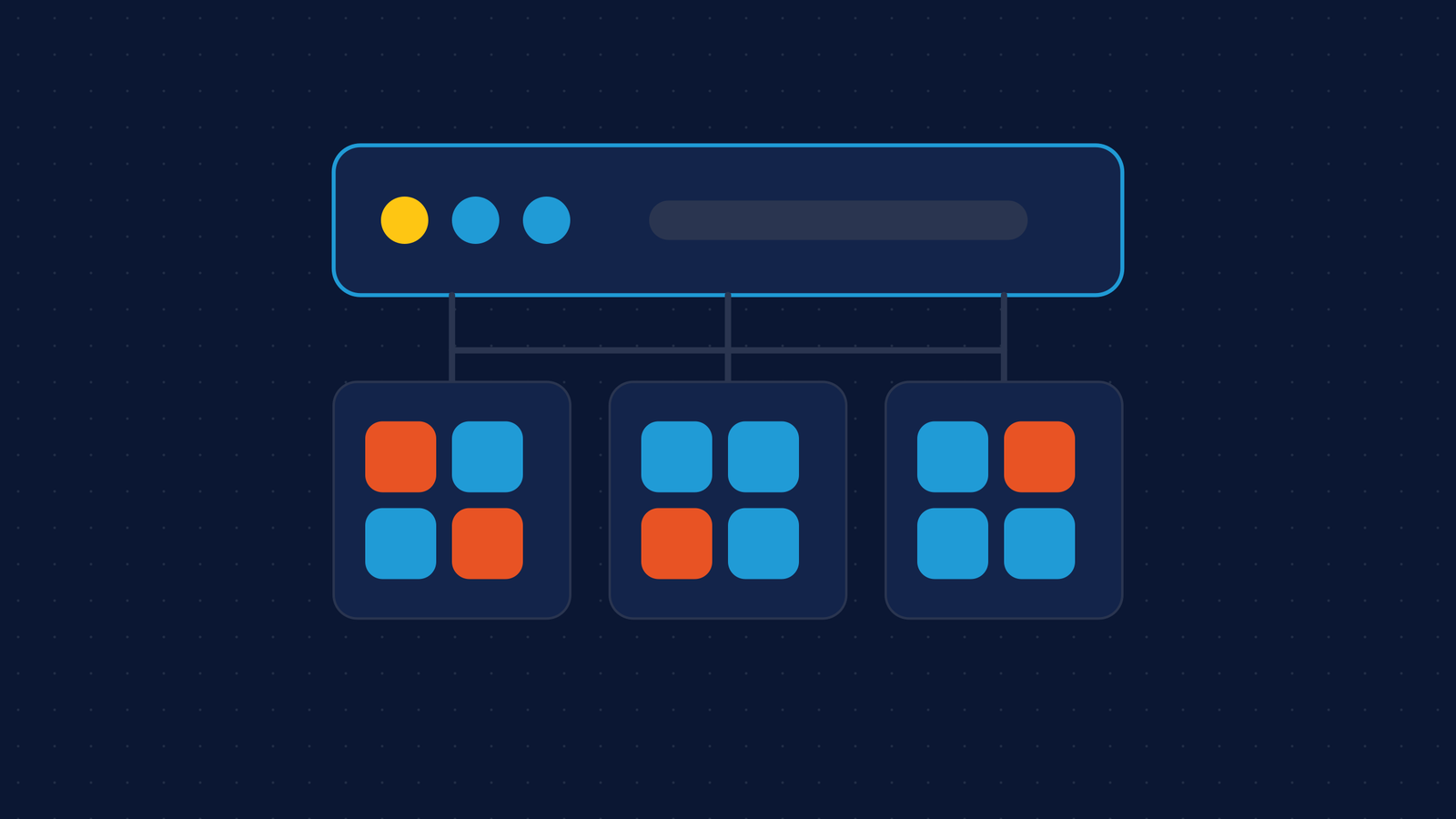
What is Kubernetes, in the project’s own words?
The Kubernetes documentation calls it a portable, extensible, open source platform for managing containerized workloads and services, with declarative configuration and automation. The servers in a cluster are called nodes. Google open sourced Kubernetes in 2014. It joined the CNCF on March 10, 2016 and became a Graduated project on March 6, 2018.
What is it for?
Four things matter most in daily use:
- Automated rollouts and rollbacks. A new version goes out gradually, and a bad one can be undone.
- Self-healing. Kubernetes restarts containers that fail and kills the ones that don’t answer a health check.
- Automatic bin packing. You declare the CPU and memory each container needs, and Kubernetes places it on a node that has room.
- Traffic and settings. Containers find each other by name, and requests are spread across copies of the same container. Passwords and settings change without rebuilding the container.
The same page says what it does not do. Kubernetes is not an all-inclusive platform as a service, a product that builds and runs your code for you. It does not build your application and does not deploy source code. The automated steps that test your code and send each version to production stay your job. How we use it with Argo CD is on our Kubernetes and Argo CD page.
What does it take to run?
Someone who owns the cluster. On a SaaS portfolio-analytics platform running on AWS EKS, Amazon’s managed Kubernetes, we had to fix behavior of the cluster itself. When the cluster packed work onto fewer servers, it recreated the log store about three times a day. Autoscaling removed most of the running report containers (Kubernetes calls them pods) at once, and the long report jobs needed an orderly shutdown.
Those fixes are part of the price of Kubernetes. If you have nobody to give them to, the cost arrives anyway, with no owner.
What if you don’t use it?
Cloud Run is Google Cloud’s managed container service. You hand it a container and it runs it.
An AI advertising platform we built for a client has one Cloud Run service, 9 jobs and 18 scheduled tasks. A version tag builds 3 images (the packaged containers), migrates the database and deploys by digest, the unique fingerprint of an image. On a government portal, each release deploys with no traffic, a job migrates the database, its health is checked, and only then is it promoted.
Cloud Run is not better. In these two cases there is one product and one team, not a fleet of services kept by many teams. What you give up is what Kubernetes adds: control over how containers are spread across nodes, and the portability its own definition stresses.
When does a company need it?
When the problem stops being the container and becomes the number of teams and services. A US transportation-services company has more than 150 active repositories deployed on Kubernetes, with several clusters on one main cloud. Our team has worked on that platform since December 2025, and Argo CD there grew from 46 to 101 applications. That company needs one common way to release to every cluster, and Kubernetes with GitOps (Git as the source of what should run) provides it.
Our rule is one question: can you name the container problem your current platform doesn’t solve? If you can’t, you don’t need Kubernetes yet. If you can, count two numbers before deciding: how many services deploy separately, and how many teams deploy them. With one service and one team, start on a managed platform.
What does it cost to adopt?
Two costs. The first is the work of building the pipelines and infrastructure around the cluster. Our CI/CD and infrastructure-as-code package builds or redesigns them for USD 4,000, in 2 weeks. The second is the person who owns the cluster afterwards. A Senior platform engineer from us costs USD 45 to 50 an hour, with a 6-month minimum, as the staff augmentation page lists.
Who can help you decide?
We start with the two numbers above and tell you if a managed platform is enough. If you are on Kubernetes or heading there, we build the release path with Argo CD and own the result. Kubernetes and Argo CD consulting explains how we work. The package behind the USD 4,000 is described in what a 2-week CI/CD and IaC rebuild delivers.
Sources
- Kubernetes, “Overview”: the definition, the features and what it does not do.
- CNCF, Kubernetes project page: the 2016 and 2018 dates.
- Client figures: the portfolio-analytics case, the transportation case and our Kubernetes and Argo CD page. Prices: pricing.
New posts by email
Notes on rates, platform engineering, DevOps, SRE, QA and AI engineering, with the prices and figures from our own work.
Check your inbox
Tell us what you need. We reply in 1 business day.
We sign an NDA before the call if you ask.
