What does engineering an online game involve?

An online game is a live service. It needs a client players run, an authoritative server that decides what happens in the world, a database that never loses or duplicates value, a launcher that updates safely and tests that play the game. Clouditive built all of that for an original online RPG, from the game bible to the restore drill.

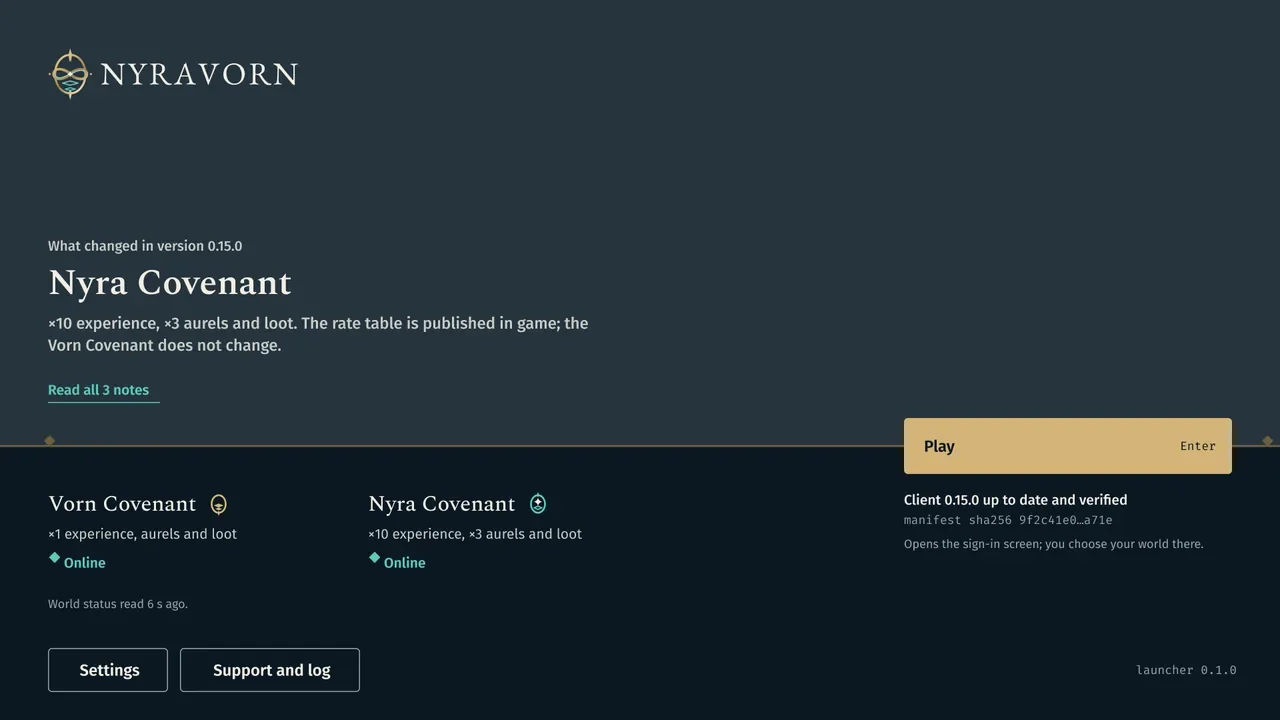
The game has two isolated worlds, Vorn Covenant (x1) and Nyra Covenant (x10), behind one login. Players form parties and clans, run quests, fight in PvP and enter tournaments.

This page makes no claim about a release date, players or revenue. It describes what we built and how it was checked.


What you get, step by step

Everything in the package, in the order it lands. The price and the duration stay the same.

  1. Step 1:

    Understand your product and its configuration end to end.

  2. Step 2:

    A full roadmap: backlog, roles, critical changes and needs.

  3. Step 3:

    Daily meetings and progress reviews with your team.

  4. 1–⁠4 weeks

    USD 7,000

Want to keep going after the package? Add engineers by the hour at the published rates, with a 6-month minimum term. How staff augmentation works.

Proven on real work

Real clients, dated figures, and a plain note on what was not done.

Clouditive built our game from zero with us: the Unity 6 client, the authoritative Java 25 server, the launcher and a value ledger that held through 40 parallel sells. 39 end-to-end smokes play the game with real Unity clients after restarting both servers.

CTO

What did we build for an online RPG?

Game launcher: release notes, two world servers with status, Play.

Clouditive built the game end to end in 286 commits over 2 days, from the game bible to the launcher.

  • A Unity 6 client with UI Toolkit, built headless in batch mode.
  • An authoritative Java 25 server on PostgreSQL 18: the server decides what happens in the world and the client presents it.
  • Two isolated worlds behind one login server, with 37 versioned protocol contracts between client and server.
  • A Tauri launcher that installs the game and verifies each update before it runs.
  • Adaptive combat and raid AI without a language model: versioned policies, compared on paired seeds, with rollback.
  • Parties, clans, quests, PvP and tournaments.

Prefer to pay by the hour?

Add engineers to your own team at the published rates instead of buying a package.

  • You interviewYou meet the engineer who will do the work.
  • 6-month minimumBilled per hour worked.
  • Free replacementIf they leave or don't fit, we replace them and cover the handover at no cost.
See how staff augmentation works
  • Lead / ArchitectUSD55–⁠60per hour
  • SeniorUSD45–⁠50per hour
  • MidUSD35–⁠40per hour
  • JuniorUSD30per hour

USD per hour, drawn to one scale

Frequently asked questions

What does Clouditive do for online games?

It builds the engineering under the game: the client, the authoritative server, the database and value ledger, the launcher, end-to-end QA and the backup and restore routine. Engineers are from LATAM and work in English, Spanish or Portuguese.

Is the game released?

This page makes no claim about a release, players or revenue. It describes what was built and how it was checked.

Did Clouditive build the whole game?

Everything in the case: the game bible and simulations, the Unity 6 client, the authoritative Java 25 server on PostgreSQL 18, the value ledger, the game AI, the Tauri launcher, the smokes and the backup and restore drill.

Does the game AI use a language model?

No. Combat and raid AI runs on versioned policies, compared on paired seeds, with rollback.

How is the economy protected from duplication?

Every movement of value goes through a transactional ledger and is never edited. 40 parallel sells left the counter, the ledger and the balance equal.

Every movement of value is written to a transactional ledger and never edited, so an item or a coin cannot be copied. Trading was hit with 40 parallel sells, and the counter, the ledger and the balance came out equal. Simulations check the design before players do: 0 duplicate builds in 10,000 and 0 duplicate full gear sets in 1,000,000.

The game's data corpus is sealed by hash, so any change to it shows.

Which stack does the game use?

Unity 6 with UI Toolkit, Java 25, PostgreSQL 18 and Tauri, with headless batch builds and Linux smokes.

Who owns the code?

You do. All code and intellectual property are yours from day 1, under an MSA and SOW, with an NDA before the first call if you ask.

How much does it cost?

Discovery is USD 7,000 for 1–⁠4 weeks. Hourly rates are USD 30–⁠60 by seniority and are on the pricing page.

Start with Discovery: USD 7,000, fixed price, 1–⁠4 weeks. We understand your game and its configuration end to end, then deliver a full roadmap with backlog, roles, critical changes and needs, with daily meetings and progress reviews. Build and QA work after that runs by project or by hour: USD 30–⁠60 by seniority, with a 6-month minimum for staff augmentation.

One client's case is not a promise; Discovery is how we size yours.

How is an online game tested before players see it?

39 end-to-end smokes start real Unity players, restart both servers and read the players' state back from PostgreSQL. 16 player flows pass in both worlds.

Backups are encrypted and scheduled, and the restore drill brings the data back in 13 s. These are checks on a build, not figures from live players.

Tell us your case.

We reply to every request within 1 business day. We sign an NDA before the call if you ask.