
A Backstage implementation costs three things: the first production version, the engineer who owns it afterwards, and the hosting. With us the first version is a fixed USD 5,000 over two weeks (IDP Foundations). Ownership runs at our hourly rates, for example USD 1,800 to 2,000 a month for a Senior engineer at 40 hours a month. Hosting is a Node.js service and a PostgreSQL database in your own cloud, billed by your provider.
We build Backstage portals and publish our prices, so the numbers here are ours and the arithmetic is yours to redo.
What are you actually paying for?
Backstage is free to download. The project calls it “an open source framework for building developer portals”, and there is no license fee. The money goes into turning a framework into a portal your engineers actually open. Our published price is on the IDP Foundations package, so you can set it next to your own numbers.
That splits three ways. Build is the first production version. Scaffold the app, wire authentication to your identity provider and connect source control. Load the software catalog, deploy it with a real database and give it a pipeline of its own. Own is everything after launch: upgrading Backstage and its plugins, fixing the catalog when ownership data goes stale, adding the next integration somebody asks for. Run is hosting the backend and its database.
Build is the easiest to estimate. Own decides whether the portal is still useful a year later.
What does the first production version cost?
A fixed USD 5,000 for two weeks. The package scope is to set up and build the internal developer platform, connect its services and ship basic views. In Backstage terms: the portal deployed in your cloud, sign-in through your identity provider, your services in the catalog, and the first views your engineers asked for.
Our exit test is simple. An engineer who wasn’t in the project opens the portal and answers “who owns this service, and is my change deployed?” without asking anyone. A portal only its builders can find their way around isn’t delivered.
Some things sit outside the package: custom plugins beyond the basic views, migrating dozens of repositories to a new template standard, or rebuilding your CI along the way. Those are either another fixed-price package (the CI/CD and IaC rebuild is USD 4,000 for two weeks) or hourly work.
What does it cost to own Backstage after launch?
This is the line people skip, and it’s the one I’d budget first. Backstage is an active project, and a portal nobody upgrades falls behind the plugins it depends on. Someone also has to keep the catalog true. A service with the wrong owner is worse than one with no page at all.
At our published rates, there are three ways to staff it:
| Option | Hours | Monthly cost |
|---|---|---|
| Senior engineer, part time | 40 h/month | USD 1,800 to 2,000 (40 × 45 to 50) |
| Architect consulting | 20 h/week | USD 4,480 |
| Senior engineer, full time | 160 h/month | USD 7,200 to 8,000 (160 × 45 to 50) |
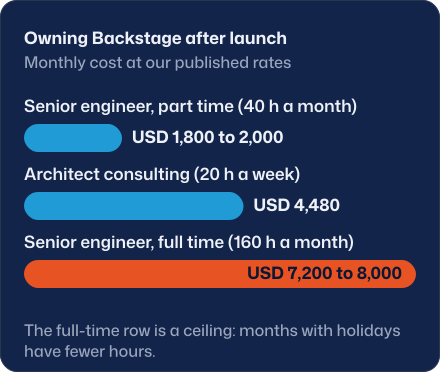
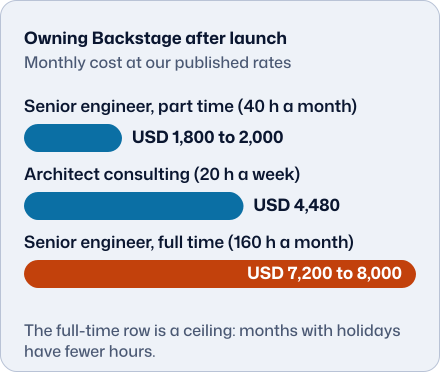
The full-time row is staff augmentation, which has a six-month minimum with us. Months with holidays have fewer hours, so treat the 160-hour figures as a ceiling.
Which row you need depends on what you want the portal to do. A portal that is mostly a catalog with TechDocs lives happily on the part-time row. One where teams create services, see costs and check CI health needs somebody building continuously.
How much does hosting cost?
There’s no useful number here, because it depends on your cloud, your region and what you already run. What I can tell you is what runs: a Node.js backend that serves the frontend, and a PostgreSQL database for the catalog and plugin data.
The getting-started install uses in-memory SQLite, and the docs say outright that it “is not a production-ready installation”. Plan on a managed PostgreSQL. If you already run Kubernetes, Backstage is one more small deployment. If you don’t, a managed container service plus a managed database is enough. Price it with your provider’s calculator, and compare it with the ownership hours before you spend a minute optimizing it.
How does that compare with hosted options?
Take a 100-developer team at list prices. Roadie, a hosted Backstage, lists USD 24 per developer per month for 50 to 150 developers, so 100 × 24 × 12 is USD 28,800 a year. It is marked “Existing subscribers only” today, so ask what a new customer is offered. Port Standard is USD 40 per seat per month, billed annually: 100 × 40 × 12 is USD 48,000 a year.
Self-hosted Backstage with us is USD 5,000 once, then USD 21,600 to 24,000 a year on the part-time Senior row (12 × 1,800 to 2,000), plus your hosting.
The two sides cover different things. The hosted options include their own upgrades and support, and the self-hosted one includes engineering hours you can spend on custom plugins. Use the numbers to frame the question, because the decision is about who owns what. If you’re still choosing between the two models, Backstage vs Port walks through it, and build or buy an internal developer platform widens the question.
What makes a Backstage implementation more expensive?
In the portals we’ve built, the hours go to four places.
The catalog comes first. Loading catalog-info.yaml files is quick. Getting accurate owners, systems and dependencies is the slow part, because that’s an organizational question. Then custom plugins: each view that reads your own systems (billing, CI statistics, profiling) is real code with tests and an owner. Then authentication and permissions, which means mapping your identity provider’s groups to who can see or trigger what. And last, skipped upgrades. Jumping several versions at once costs more than keeping up.
For a portfolio-analytics SaaS platform, the portal grew to 22 modules across 10 plugins. They cover service and API catalogs from OpenAPI, a dependency map, deploy status, cost views fed from the cloud billing API, image vulnerabilities, CI health with 30-day flake and retry statistics, and profiling diffs between deploys. That’s the full-time end of the table. Nobody should start there.
How do I keep the cost down?
Start with three questions, not twenty plugins: who owns this, is it deployed, what does it cost. Build the views that answer those. Make one person the owner from day one, even at 40 hours a month, and upgrade on a schedule, small and often.
Generate the catalog from what already exists (OpenAPI specs, repository metadata) instead of asking every team to fill in forms. Forms go stale in a month.
If you want a known first number in your budget, start with IDP Foundations: USD 5,000, two weeks. Price the ownership line after you’ve seen which views your engineers actually open. Every package and hourly rate is on the pricing page.
Sources, accessed 2026-10-07: Backstage docs, Backstage, Getting Started, Roadie pricing, Port pricing.
Port and Roadie are trademarks of their respective owners. Clouditive is not affiliated with them.