
An AI agent has two costs, and most people only ask about the first. Building it is a one-time engineering cost: our AI Agent Pilot puts one agent on one real use case in two weeks for a fixed USD 5,000. Running it costs money on every task, which is model calls times tokens times the provider’s price, plus retries and checks. That second number decides whether the agent survives.
We learned to watch it on a platform we built for an AI marketing client, an advertising service where one AI system plans campaigns and generates the pieces. It keeps a cost ledger for every model call, and we choose models by what an approved piece costs.
Do you need an agent at all?
Anthropic’s guide to building effective agents draws the line well. Workflows are “systems where LLMs and tools are orchestrated through predefined code paths”. Agents are “systems where LLMs dynamically direct their own processes and tool usage, maintaining control over how they accomplish tasks.” The same guide says to start with the simplest option, which “might mean not building agentic systems at all”. The reason is that agentic systems “often trade latency and cost for better task performance”.
I agree, and it’s the first thing a pilot should test. Plenty of the “agents” people bring me would be better as a plain workflow: cheaper, faster, easier to verify. A pilot that ends with “you need a workflow” has saved you money. If you’d rather test that on your own case first, the AI Agent Pilot is the fixed-price way we do it.
What does it cost to build one?
Ours is a fixed price: AI Agent Pilot, USD 5,000, two weeks. One agent working on one real use case, with evals and cost per task measured. If you’d rather add an AI engineer to your team by the hour, a Senior is USD 45 to 50 and a Lead or Architect USD 55 to 60. The whole table is on the pricing page.
Over the life of an agent, the build is rarely the big number. Running it is.
What does it cost to run one?
Every task the agent completes costs this:
cost per task = Σ over model calls ( input_tokens × input_price
                                    + output_tokens × output_price ) / 1,000,000
              + cost of retries
              + cost of checks (validators, judge models, human review time)
Providers publish per-million-token prices, and Google lists its own on the Vertex AI pricing page. They change often. Read them the day you do the math, which is also why this post quotes none.
The monthly figure is then:
monthly cost = cost per task × tasks per monthFive agents is the same sum five times, each with its own volume. Five agents doing ten tasks a day cost something very different from one agent doing ten thousand.
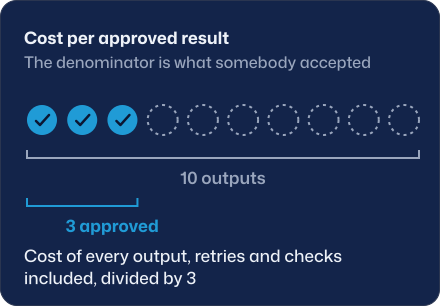
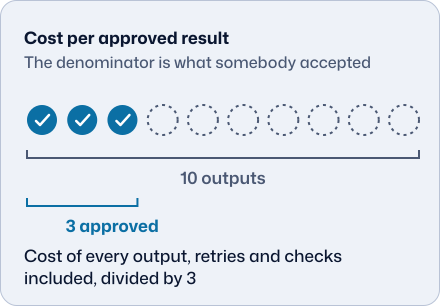
What most teams miss is the denominator. An agent that produces ten outputs and gets three approved costs ten outputs to get three useful ones. So we track cost per approved result, never cost per call.
What does running AI in production teach you?
The AI marketing platform is the clearest case we have, because we built it. One AI system diagnoses a client’s brand, plans campaigns, generates the pieces and schedules them on social networks, and a person approves every piece. Several model stations run on Vertex AI, mixing open models and Gemini, so no single vendor holds the whole thing.
A panel of independent AI judges blocks pieces with verifiable defects, and it never approves anything on its own. Each judge seat is measured against labelled examples before it goes into service, and we have tools to calibrate the judges against human labels, so they’re checked against people too.
Three lessons carry over to almost any agent. A model that checks another model’s output is software, and it needs its own test set before you trust it. The cheapest model per token can be the most expensive per useful result. And where a decision can’t be undone, keep a person in it. Nothing on that platform is published until someone approves it.
What happens in the two-week pilot?
You pick the use case. We start from the task and from how you would tell a right answer from a wrong one, because if a person can’t judge the output, no eval can. Then we build the evaluation set from real examples with the expected outcome, so “it works” becomes a number.
After that comes the simplest version that could work, with every model call instrumented for tokens and cost. It is often a workflow first, and an agent only if the task needs dynamic tool use. We run it and report four things: approved results, how it failed, cost per approved result, and what production would take.
At the end you know whether the agent is worth building further and what it would cost per month at your volume. Both are things you can put in front of whoever approves budgets.
Can I build an AI agent myself?
Yes. The frameworks are open and the model APIs are documented, so the difference between a good agent and a bad one is discipline: an evaluation set before the first prompt and cost measured per call from day one. Add a clear rule for what the agent may do without a person.
If your team already works that way, build it yourselves. If you’d rather see it set up once and pick up the habit, that’s what the pilot is for.
What goes wrong most often?
In our own builds, the same few things. No evaluation set, so every prompt change is a guess. Cost read off the monthly invoice instead of per call, by which time the problem is weeks old. A judge model that approves things, which is a liability unless someone measured it. An agent where a workflow would have done, with the extra latency, cost and failure modes that come with autonomy.
And a model call buried so deep in the code that switching models turns into a project. Wrap it early.
Is an AI agent worth it?
When the task is repetitive, you can judge the result, and people find it expensive, usually yes. When it’s rare, ambiguous or high-stakes with nobody checking, usually no. A fixed-price pilot lets you find out with real numbers for USD 5,000, instead of with a six-month project. AI agent examples shows what we’ve seen work and what we haven’t.
If you have a task in mind, write down how you would tell a good output from a bad one. If that takes more than a paragraph, say so on the first call. Then start the AI Agent Pilot: USD 5,000, 2 weeks.
Sources, accessed 2026-10-06: Anthropic, “Building effective agents”, published 2024-12-19 (I use only its definitions, since the page says some of the tooling it describes has changed), and Vertex AI generative AI pricing.