
At DX Clouditive a nearshore LATAM engineer costs USD 30 an hour at junior level, 35 to 40 at mid level, 45 to 50 at senior level and 55 to 60 for a lead or architect. A Senior for 160 hours comes to USD 7,200 to 8,000. Fixed-scope packages start at USD 2,500 (a one-week Cloud Cost Review) and top out at USD 7,000 (a one-to-four-week Discovery).
We publish our rates and the fixed price of every package, so a budget can start before the first call. Here is what the numbers cover and how I’d compare them if I were the one buying.
How much does a nearshore developer cost per hour?
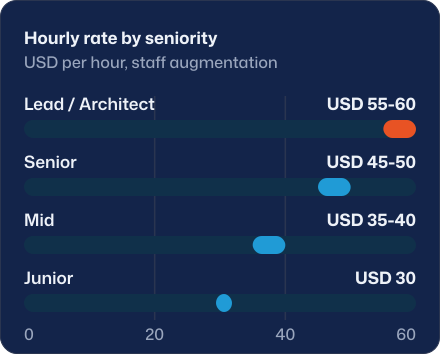
These are our staff augmentation rates in US dollars, with the arithmetic for one full-time engineer at 160 billable hours a month:
| Seniority | USD / hour | Full month at 160 h |
|---|---|---|
| Lead / Architect | 55-60 | 8,800-9,600 |
| Senior | 45-50 | 7,200-8,000 |
| Mid | 35-40 | 5,600-6,400 |
| Junior | 30 | 4,800 |
The formula is rate × hours. Months with holidays have fewer hours, and part-time scales down in proportion. The same rates, with how an engagement works, are on our staff augmentation page.
The rates are ranges because “senior” covers a lot of ground. Someone who has run production Kubernetes clusters for years and someone who is strong on one framework are both senior, and they aren’t the same hire. Tell us the role and we’ll tell you where it sits. Senior (45 to 50) and Lead / Architect (55 to 60) don’t overlap, so moving up a level means moving up a band.
The engineers are in LATAM and work between UTC-3 and UTC-5, with delivery in English or Spanish, whichever your team uses. Staff augmentation has a 6-month minimum and is billed per hour worked. You interview the engineer who will do the work. If that engineer leaves or doesn’t fit, we replace them and cover the handover at no cost.
How do these rates compare with US salaries?
Carefully, because the two numbers measure different things. The US Bureau of Labor Statistics reports that software developers (SOC 15-1252) earned a median hourly wage of USD 65.38 and a mean of USD 71.20 in May 2025, across about 1.7 million jobs. Software QA analysts and testers (SOC 15-1253) earned a median of USD 50.14 and a mean of USD 53.60.
Those are wages paid to employees. They leave out the employer’s benefits, payroll taxes, equipment, recruiting and the months it takes to hire. Our rate is a price billed per hour of work. Putting them side by side as if they were the same unit is a common mistake in nearshore pricing articles.
What you can say is short. A US developer’s median wage alone is USD 65.38 an hour, and what that person costs the company per hour is higher. Our senior range is USD 45 to 50 an hour, billed. The comparison that matters is your own fully loaded cost per productive hour against our rate, and only you have the first number.
To get it, take what HR says one engineer costs per year, all in, and divide by the hours that engineer actually spends shipping. That’s the figure to hold next to our rate card.
Staff augmentation or a fixed-scope package?
They answer different questions, so they’re priced differently.
Staff augmentation buys capacity. An engineer joins your team, works in your tools, takes direction from your leads, and you pay by the hour. It fits when the work is ongoing and you already know what to build. How it works with us is on its own page.
A fixed-scope package buys an outcome with a deadline. CI/CD and infrastructure as code takes two weeks for USD 4,000. The foundations of an internal developer platform take two weeks for USD 5,000. It fits when the result is clear and bounded and you’d rather not manage hours.
My rule of thumb with buyers: if you can write the acceptance criteria on one page, buy the package. If you can’t, buy hours, or buy the Discovery first.
What does each package include?
Each one is scoped by outcome.
| Package | Price | Duration | What you get |
|---|---|---|---|
| Cloud Cost Review | USD 2,500 | 1 week | A complete backlog, a FinOps report with the areas to optimize and the improvements to make, the state of all your resources, where you spend more than you need to and where you are at the limit |
| CI/CD & IaC build or re-architecture | USD 4,000 | 2 weeks | Your CI/CD pipeline and the infrastructure as code under it, built or re-architected |
| IDP Foundations | USD 5,000 | 2 weeks | The internal developer platform set up, its services connected, basic views |
| AI Agent Pilot | USD 5,000 | 2 weeks | One agent on one real use case, with evals and cost per task measured |
| QA Automation Foundations | USD 5,000 | 2 weeks | A Playwright suite for your 5 critical flows running in CI, plus accessibility checks |
| SRE / Observability Foundations | USD 5,000 | 2 weeks | Metrics, logs and traces wired, 3 SLOs defined, alerts proven to fire, a runbook |
| Discovery | USD 7,000 | 1-4 weeks | The product and its configuration understood end to end, with a full roadmap: backlog, roles, critical changes and needs, plus daily meetings and progress reviews |
| Architect consulting | USD 4,480 / month | ongoing | 20 hours a week of an architect for design, consults, follow-ups and building architectures |
The pricing page has all of it, and it’s the first page we update if anything changes.
How should I budget for a nearshore engineer?
Decide hours or outcome first: ongoing capacity goes to staff augmentation, a bounded result goes to a package. Then pick the seniority by the decisions the person will make alone. If nobody on your side will review their architecture choices, you need a senior or a lead.
Then multiply by real hours. rate × 160 is the ceiling for a full month, and you adjust for holidays in both countries. Add your own overhead, because onboarding time from your team, accounts, licences and reviews aren’t on our invoice but they are on your budget. And check the time-zone overlap: UTC-3 to UTC-5 gives at least 4 hours with US Eastern and 2 with US Pacific.
If you’re comparing vendors, ask each one, us included, what exactly moves someone from the bottom of the range to the top. Ask whether the rate is the same in month one and month twelve. Ask who pays for the ramp-up. A vendor who answers those in writing has a rate card that means something. Toptal and BairesDev alternatives shows what other firms print.
Is cheaper always better?
No. The cost that hurts in outsourced engineering is rarely the hourly rate. It’s the rework when nobody verified the work, the release that broke because the pipeline had no gate, the month spent onboarding someone who then leaves. In our own delivery, infrastructure is code with encrypted state. Releases go out by tag and deploy by image digest. User flows are checked in a real browser before anything is called done. That practice is what the rate pays for.
If a lower rate elsewhere tempts you, ask what happens in that vendor’s process between “the code compiles” and “it works in production”. The answer is usually where the price difference comes from.
When you’re ready, price your case on the pricing page, from USD 30 an hour or USD 4,000 for a 2-week package.
Sources: BLS Occupational Employment and Wage Statistics, May 2025 national series for SOC 15-1252 and 15-1253, queried 2026-10-06.