
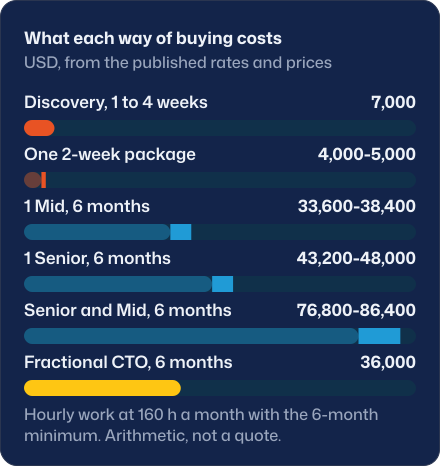
Custom software costs rate times hours, plus whoever leads it. The honest range depends on how you buy it, not on what kind of app it is. Knowing what to build costs USD 7,000 (Discovery). One bounded technical result costs USD 4,000 to 5,000. A product team at hourly rates costs USD 43,200 to 48,000 for one Senior over the 6-month minimum, and USD 76,800 to 86,400 for a Senior and a Mid. That is arithmetic from our published prices, not a quote.
I won’t tell you that an MVP costs one number and a marketplace another. I don’t publish those because the same app can take eight weeks or eight months depending on its scope, and a price without a backlog is a guess. So the ranges below are by how you buy.
What does custom software cost, by how you buy it?
Each row is a published price or published rate times hours. Hourly work is billed per hour worked, at 160 hours a month, with a 6-month minimum. If you’d rather scope a project than buy hours, this is how our projects work.
| You are buying | Price (USD) | Time |
|---|---|---|
| Knowing what to build: Discovery | 7,000 | 1-4 weeks |
| One bounded technical result: CI/CD & IaC, internal platform, AI agent pilot, QA automation or SRE | 4,000-5,000 | 2 weeks |
| One Mid engineer | 33,600-38,400 | 6 months |
| One Senior engineer | 43,200-48,000 | 6 months |
| A Senior and a Mid | 76,800-86,400 | 6 months |
| A Lead, a Senior and a Mid | 129,600-144,000 | 6 months |
| Technical leadership on top: Fractional CTO | 36,000 | 6 months |
The rates behind the hourly rows are explained in Nearshore developer rates in 2026. The fixed prices are on the pricing page.
We build products from nothing, so I’m not working from theory. A govtech client portal reached production in 20 days. The public site of a housing-support service went live in 3. An AI marketing platform went from first commit to production in 15 days, built by a very small human team directing AI engineering agents. Those are durations, not prices. What each client paid is not ours to publish, and I’d distrust a number that skips scope.
What decides the number?
Three things: scope, team and duration. The formula is the same for every build:
cost = sum of (rate × hours, per person)
       + technical leadership + your own time
Rate is the easy part, and it’s printed. The hours are where estimates go wrong, and they go wrong on scope, not on rate. A feature list is not a scope. “Users can pay” hides how many ways they pay, what happens when it fails, who refunds, and who gets told.
Your own time is the line people leave out. Someone on your side decides, reviews and answers questions. If nobody can, buy leadership: a fractional CTO is USD 6,000 a month for 30 hours a week, and which of the options fits a non-technical founder is its own post.
How do you estimate it?
Six steps, in this order:
- Write the flows, not the features. A flow is something a user does from start to finish: sign up, pay, get a report.
- Rank each flow as must, should or later. The first release is the musts.
- Give every flow a range in weeks, an optimistic and a pessimistic one, from someone who has built something similar. The width of the range is your uncertainty. Don’t average it away.
- Turn weeks into hours and hours into dollars with the band of the seniority that would do the work. A person-month is 160 billable hours.
- Add leadership and your own time.
- Re-estimate after two weeks of real work. Velocity measured on your codebase is worth more than any guess before it.
Where the ranges stay wide after step 3, don’t build yet. Buy Discovery: 1 to 4 weeks that end in a full roadmap with the backlog, roles, critical changes and needs. And if you want to calibrate before committing to the 6-month minimum, start with any 2-week fixed-price package.
Can the estimator on the pricing page do this?
Part of it. The estimator on the pricing page takes a sentence, like a Senior engineer for 320 hours or two Mid engineers in DevOps for 160 hours, and returns the arithmetic from the published bands. If what you type matches a package, it shows the package price. It covers the areas we sell: AI, platform, DevOps, SRE, QA and forward deployed engineering.
It does not know your scope. It multiplies. Use it at step 4, to turn the hours you estimated into dollars, and treat the result as an estimate, not a quote.
What does software cost after you build it?
Running it. Cloud, licences, monitoring and a person who answers when it breaks. None of those is in the table above, and all of them recur. Two other posts show how to measure them: cutting a cloud bill for infrastructure, and what an AI agent costs for the per-task cost of a model. And the cost of keeping people on the code is its own comparison: in-house versus outsourced.
What should you do this week?
Write your flows on one page and give each a range in weeks. Put the hours into the estimator. If your ranges are narrow, you may not need anything else. If they are wide, bring the page to a call: it is what Discovery starts from, and we’d rather tell you that than sell you the longer thing.
Sources
- Our rates and prices: the pricing page, consulted 2026-10-09. Every total in this post is that price times the hours stated.
- Build durations: our case pages on the govtech coordination portal, the housing platform and the AI marketing platform.