
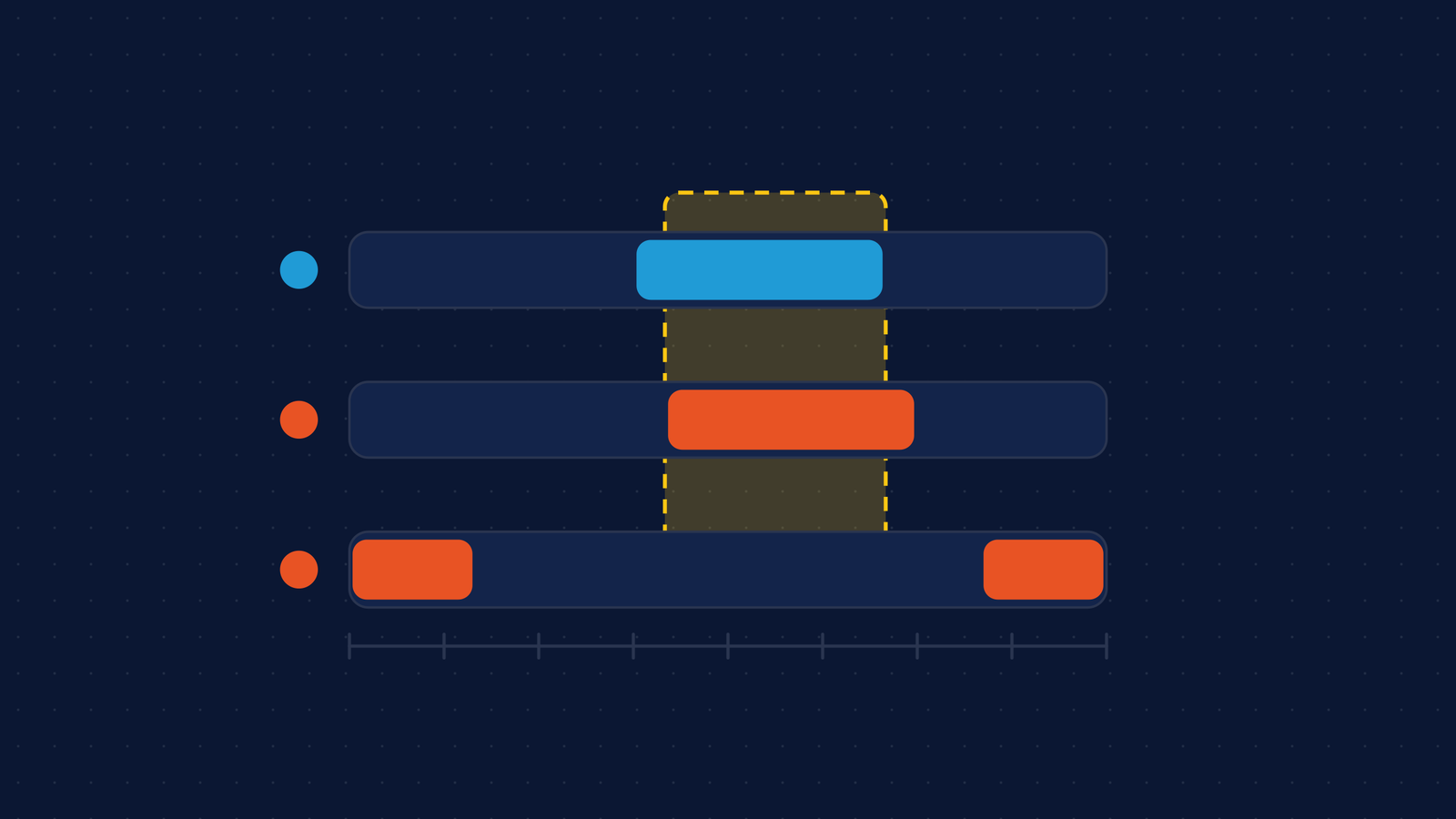
Nearshore means your engineers work from a nearby country in a similar time zone. Offshore means a distant one, often on the other side of the world. For a US team, engineers in Latin America share six to eight hours of a 9-to-5 day with New York, while engineers in India or the Philippines share none. That overlap, more than the hourly rate, changes how engineering work gets done.
I’m not neutral here. We run a nearshore model, with engineers in LATAM working for clients across the Americas in English or Spanish. So I measured the overlap instead of quoting a chart, and I say below where offshore is the better choice.
What’s the difference between nearshore and offshore?
Both mean the engineers are in another country. The difference is distance, which in practice means time zones. Onshore is your own country. Nearshore is a neighbouring region with a similar clock: for the US that’s Latin America, for Western Europe it’s often Central or Eastern Europe. Offshore is a distant region where the working day barely overlaps with yours, or doesn’t at all.
No regulator defines these words and vendors use them loosely. The definition that holds up is one you can measure: how many of your working hours are also theirs. Our staff augmentation page has the rates and terms of the nearshore model I’m comparing.
How many working hours overlap?
The IANA time zone database has the answer. The script takes a 9:00 to 17:00 day in each city on a given date and counts the hours inside both windows:
from datetime import datetime, timedelta
from zoneinfo import ZoneInfo

def window(zone, day):
    start = datetime(*day, 9, 0, tzinfo=ZoneInfo(zone))
    return start, start + timedelta(hours=8)

def overlap(a, b, day):
    (a0, a1), (b0, b1) = window(a, day), window(b, day)
    return max(timedelta(0), min(a1, b1) - max(a0, b0))

print(overlap("America/New_York", "America/Bogota", (2026, 10, 7)))  # 7:00:00
Here are the results for a weekday in October 2026 (US on daylight time) and in January 2027 (US on standard time):
| Engineer in | With New York, Oct | With New York, Jan | With Los Angeles, Oct | With Los Angeles, Jan |
|---|---|---|---|---|
| Mexico City | 6 h | 7 h | 7 h | 6 h |
| Bogotá | 7 h | 8 h | 6 h | 5 h |
| Buenos Aires | 7 h | 6 h | 4 h | 3 h |
| Warsaw | 2 h | 2 h | 0 h | 0 h |
| Kolkata | 0 h | 0 h | 0 h | 0 h |
| Manila | 0 h | 0 h | 0 h | 0 h |
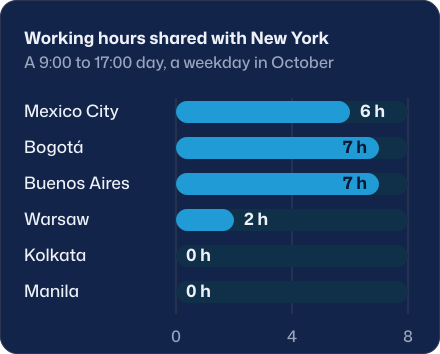
The cities are there to measure the clock. About where our engineers live, we only say “LATAM”.
Overlap moves with the seasons, because the US changes its clocks and most of Latin America doesn’t. And an offshore team can still overlap with you if someone works a shifted day. That’s a real option, but somebody pays for it, usually the engineer.
Which is better, nearshore or offshore?
It depends on the work you’re sending.
Offshore works well for work you can specify completely and hand over: a well-defined backlog of features, testing against a written plan, a migration with clear rules. The time difference can even help, since what you hand off at the end of your day can be done by the next morning.
Nearshore works better when the work depends on fast answers. DevOps and platform work, where a broken pipeline blocks your developers right now. SRE and incident response, where the person who knows the system has to be awake when it breaks during your business hours. Pairing, design reviews and discovery, where a question left unanswered for twelve hours costs a day. And anything client-facing, where the engineer sits in your customer’s meetings.
The more your work depends on conversation, the more overlap is worth.
Does nearshore cost more than offshore?
Often, per hour. Whether it costs more per result is a different question, and the overlap table turns into costs that never show up on an hourly rate. A blocking question asked at 10:00 in New York gets answered at 10:05 with six hours of overlap, and tomorrow without it. An ambiguous requirement gets cleared up in a call instead of being built wrong overnight. And with zero overlap, somebody takes calls at 22:00. That works for a while, not forever.
We publish our hourly rates so you can do this math with real numbers. The rate card has every seniority and every fixed-price package. Nearshore developer rates in 2026 works out a full month. Set it against your current offshore rate plus the cost of the waiting you actually observe.
What does nearshore outsourcing look like in practice?
A nearshore developer is an engineer who works for your company from a nearby country in a similar time zone, employed by a vendor (staff augmentation) or contracted directly. With us they join your team through staff augmentation or deliver fixed-scope projects, in English or Spanish, whichever your team uses.
Two examples from our work. A US IT consultancy and Clouditive partner uses our nearshore LATAM engineers to meet its own clients’ demand. It also sources talent across Latin America more economically, so it can compete better.
At a portfolio-analytics SaaS client, one Clouditive platform engineer working with an AI agent sits alongside the client’s DevOps lead and about 8 engineers on its platform. The work covers GitOps promotion pipelines with verification gates, an internal developer portal on Backstage, infrastructure as code and observability. Production releases per week are about three times what they were from April to July 2026, measured over the latest 30 days. In October 2026 the first production release went through the new promotion pipeline with all 12 running service images verified against the release. A rollback rehearsed in dev took a bit over a minute back and about two minutes forward.
That second example is exactly the kind of work that gets hard with zero overlap. Release gates, rollbacks and production fixes happen during the client’s day.
Why does offshoring have a bad name?
Mostly for reasons that have little to do with geography: projects specified badly and thrown over a wall, vendors measured on hours instead of results, quality nobody verified until production. A nearshore team can fail the same way. Distance only makes the failure slower to notice, which makes it more expensive.
The fix is process, wherever the team sits. In our delivery that means infrastructure as code with encrypted state, release by tag and deploy by digest, architecture boundaries enforced before every push, and real-browser QA with accessibility checks. Those make work verifiable from anywhere. Overlap makes it quick to correct.
How do I choose?
List your work and mark each item “can be fully specified” or “needs conversation”. Measure the overlap for your real cities with the script above, in summer and in winter. For the “needs conversation” items, estimate how many blocking questions come up per week and put a price on the waiting. Then ask every vendor how it proves work is done: what runs before a merge, how releases are deployed, how rollbacks are tested.
If most of your list is “needs conversation”, nearshore is probably the better fit. See how our nearshore model works: LATAM engineers in English or Spanish, from USD 30 an hour by seniority.
Source: IANA time zone database, used through Python’s zoneinfo for a 9:00 to 17:00 day in each city, computed 2026-10-06.