

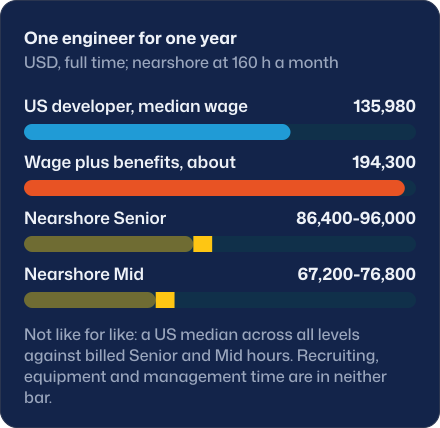
A US software developer at the median wage costs about USD 194,000 a year once benefits are added, or about USD 93 for each hour worked. Our nearshore Senior is USD 45 to 50 an hour, billed, which is USD 86,400 to 96,000 over twelve months at 160 hours. Those two numbers are not like for like, and neither includes recruiting. Below is the arithmetic, what each side leaves out and where the answer flips.
We staff engineers into other companies’ teams, so I have a stake in this one. I’ll show the sources so you can redo it with your own numbers.
What does an in-house engineer cost?
Start with the wage. The US Bureau of Labor Statistics reports a median annual wage of USD 135,980 for software developers (SOC 15-1252) in May 2025, an hourly median of USD 65.38 across about 1.7 million jobs. That is what the person is paid. To price the other side, our staff augmentation rates are published by seniority.
Then add what the employer pays on top. The BLS Employer Costs for Employee Compensation series put benefits at 30.0% of total compensation for private industry in the second quarter of 2026. Wages were the other 70.0%. So the wage is 70% of the cost, and 135,980 divided by 0.70 is about USD 194,000 a year. For the hourly median, 65.38 divided by 0.70 is about USD 93.
| Line | Per year (USD) | Source |
|---|---|---|
| Median wage, software developer, US | 135,980 | BLS OEWS, May 2025 |
| Wage as 70% of total compensation | about 194,300 | BLS ECEC, Q2 2026 |
| Recruiting, equipment, licences, onboarding, management time | Not measured here | Yours to price |
Three caveats on those numbers. The median covers every level, so it sits under what a Senior earns. The 30% share is for all private-industry workers, not developers specifically. And all of it is US data: it says nothing about hiring in another country.
What does an outsourced engineer cost?
A rate times hours. Ours are USD 30 an hour for a Junior, 35 to 40 for a Mid, 45 to 50 for a Senior and 55 to 60 for a Lead or Architect, billed per hour worked, with a 6-month minimum. At 160 hours a month that is USD 5,600 to 6,400 for a Mid and USD 7,200 to 8,000 for a Senior. There is no fee on top of rate × hours. You interview the engineer who will do the work, and if that engineer leaves or doesn’t fit, we replace them and cover the handover at no cost. All code and IP are yours from day one.
What is not on our invoice but is in your budget: the hours your own people spend onboarding and reviewing, the accounts and licences, and a manager’s attention. They exist on both sides. I’d price them for the outsourced option too.
Is this a fair comparison?
No, and I’d distrust anyone who says it is. A US median across every seniority level is being set beside a billed Senior. The in-house number includes paid leave and the outsourced one does not. And I have no cited number for what a developer costs if you hire directly in Latin America, so I won’t make one up. If that is your real alternative, run the same three lines with that salary and your country’s employer costs.
What the arithmetic does say is narrower. If your alternative is a US hire at a US wage, the loaded cost per hour worked is roughly twice our Senior rate. If it isn’t, you need your own numbers, and finance has them.
What do neither of those numbers include?
For in-house: the time to fill the seat, the weeks a role sits empty, and what it costs when the person leaves. I have no measured figure for those, and the ones you’ll find in articles are rarely sourced.
For outsourced: coordination and context. The cost that hurts is rarely the rate. It is rework when nobody verified the work, a release that broke because the pipeline had no gate, a month spent onboarding someone who then leaves. That is a question about process, not price, and Nearshore developer rates in 2026 goes through what to ask a vendor about it.
On our side, a candidate is in front of you within 5 business days. Engineers use your own accounts with SSO and MFA and least privilege, and those are revoked when the engagement ends. We don’t offer 24x7 on-call: we work in your business hours and leave alerts and runbooks for your own.
When does in-house win?
When the work is continuous, the horizon is years, and the knowledge compounds. A core product you will build for a decade wants people who stay. It also wins when you need a person on call outside business hours, and when you can hire and keep the people at a cost you can see.
Outsourcing wins on bounded or lumpy work: a platform to set up, a test suite, observability, an AI agent pilot, a migration. It wins on speed to start and on seniority you can’t afford to keep full time.
My test: what would this person do in month 13? If you can name the work, a permanent hire can make sense. If you can’t, you are renting capacity either way, and renting it at a price you can read is cheaper than renting it through a vacancy.
Can you mix both?
Most real teams do. At a portfolio-analytics SaaS platform, one of our platform engineers works with an AI agent alongside the client’s own DevOps lead and about 8 of its engineers. The engagement started in January 2025 and continues. The client’s engineers keep the product work, and ours works on the platform, delivery and observability side.
How do you run the numbers for your case?
extras = recruiting + equipment + onboarding + management
in-house per hour   = hourly wage / 0.70
                      + extras / hours you keep the person
outsourced per hour = rate + your onboarding and review time
Replace 0.70 with the ratio your payroll shows if you have it. Then compare the two on the same seniority and the same number of months. You can try ours on the pricing page: the estimator takes a sentence, like a Senior engineer for 320 hours, and returns the arithmetic from the published bands. It is an estimate, not a quote. Our staff augmentation page has the terms, and nearshore versus offshore covers the time-zone side of the comparison.
This week, ask finance for the all-in annual cost of one engineer you have today, divide it by the hours that person works, and put the result next to USD 45 to 50. If the gap isn’t what you expected, tell me what you are comparing against and we’ll look at it together.
Sources
- US Bureau of Labor Statistics, Occupational Employment and Wage Statistics, software developers (SOC 15-1252), annual median wage and hourly median wage, May 2025, accessed 2026-10-09.
- US Bureau of Labor Statistics, Employer Costs for Employee Compensation, benefits as a share of total compensation and wages as a share, private industry, second quarter 2026, accessed 2026-10-09.
- Our rates, terms and packages: the pricing page, consulted 2026-10-09.