

Staff augmentation adds engineers to your team: you direct them and pay by the hour. Managed services hand a whole function to a vendor, who owns the outcome under a service agreement. A fixed-scope project buys one defined result at a fixed price and date. Pick by who should own the decisions: you (augmentation), the vendor permanently (managed), or the vendor for one bounded result (project).
We sell two of the three, staff augmentation and fixed-scope projects. We don’t sell managed services. I’ll explain all three anyway, because picking the wrong model costs more than picking the wrong vendor.
What is staff augmentation?
A vendor supplies engineers who work inside your team as if they were your own: your backlog, your standups, your repositories, your code review. You decide what they work on. The vendor handles sourcing, employment and replacement, and bills you for hours worked. You’ll also see it called team augmentation or IT staff augmentation. Same model.
What defines it is who directs the work, and in augmentation that’s you. So it’s the right model when you already have engineering leadership and a clear backlog, and what you lack is hands, or one specific skill like platform engineering, SRE or QA automation. Our terms for the first one are on the staff augmentation page.
Ours is nearshore: engineers in LATAM working with teams across the Americas, delivering 100% in English or Spanish. You interview the engineer who will do the work. If that engineer leaves or doesn’t fit, we replace them and cover the handover at no cost. The minimum term is 6 months, billed per hour worked.
What are managed services?
In a managed services contract a vendor takes over a function, say running your infrastructure or your help desk, and answers for results defined in a service-level agreement. You don’t direct individual engineers. You hold the vendor to the agreement. Pricing is usually a recurring fee for the scope covered.
It fits when the function is stable, well understood and not where you compete. It fits badly when the function changes every quarter, because each change becomes a contract conversation.
We don’t offer this. If you need a vendor to run a function on its own under an SLA, we’re not the right fit.
What is a fixed-scope project?
It buys a defined outcome for a fixed price and a fixed duration. The vendor directs the work toward acceptance criteria you agree on up front. When it’s done, it’s done, and you own the result.
That’s how we sell our packages. A few from the price list:
| Package | Price | Duration |
|---|---|---|
| CI/CD & IaC build or re-architecture | USD 4,000 | 2 weeks |
| IDP Foundations (set up the internal developer platform, connect its services, basic views) | USD 5,000 | 2 weeks |
| Discovery (understand the product end to end, deliver a roadmap with backlog, roles, critical changes and needs) | USD 7,000 | 1-4 weeks |
AI Agent Pilot, QA Automation Foundations and SRE / Observability Foundations are USD 5,000 for 2 weeks each. Architect consulting is USD 4,480 a month for 20 hours a week of an architect.
How is staff augmentation different from outsourcing and consulting?
“Outsourcing” is the umbrella word. Managed services and projects are both outsourcing, because the vendor owns the outcome. Staff augmentation is the exception: the engineers come from outside and the outcome stays with you.
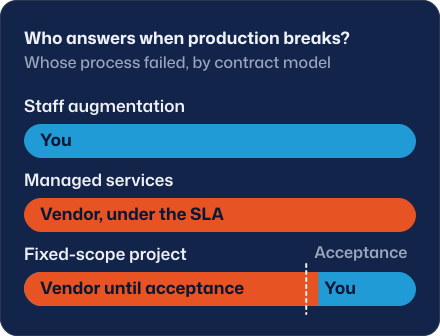
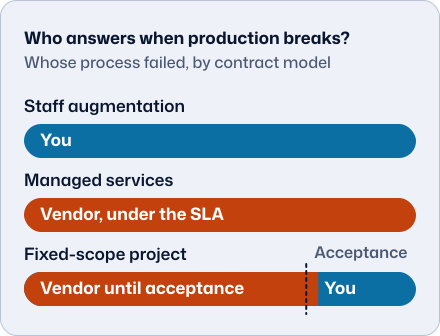
A quick test is to ask whose process failed when something breaks in production. With augmentation, yours, because your team was directing the work. With managed services, the vendor’s, under the SLA. With a project, the vendor’s until acceptance and yours afterwards.
Consulting sells judgment: someone tells you what to do. Augmentation sells execution: someone does what your team decided. Good augmented engineers bring judgment too, and good consultants build, but the contract tells you who is accountable for the decision. Our Architect consulting package sits between the two. You get the judgment, and a person who stays around to see it built.
How much does staff augmentation cost?
With us, the price is the hourly rate for the seniority times the hours worked.
| Seniority | USD / hour | Full month at 160 h |
|---|---|---|
| Lead / Architect | 55-60 | 8,800-9,600 |
| Senior | 45-50 | 7,200-8,000 |
| Mid | 35-40 | 5,600-6,400 |
| Junior | 30 | 4,800 |
The monthly column is plain arithmetic, rate × 160, and real months with holidays have fewer hours. What the table leaves out is your own cost of directing the engineer: onboarding time, reviews, accounts. In augmentation that cost is real and it sits on your side. Nearshore developer rates in 2026 shows how to compare our rate with US salaries.
How does an engagement start, run and end?
In writing, from the first call to the exit:
- You tell us the seniority, the area and the weekly hours. We reply within 1 business day and present candidates within 1 week.
- You interview the engineer who will do the work. If you’re not sure yet, start with a 2-week fixed-price package, from USD 4,000, and see how we work before the 6-month minimum begins.
- The engineer works in your accounts, with SSO, MFA and least privilege, and is billed per hour worked at the published band. Invoices are in US dollars, monthly in arrears, net 15.
- If the engineer leaves or doesn’t fit, we present a replacement within 10 business days and cover the handover at no cost.
- After the 6 months, 30 days’ notice ends the engagement. The code and the intellectual property are yours from day 1.
Every term is on one page: hire engineers.
Which model should I choose?
Choose staff augmentation when three things are true at once. You have someone to direct the work (an engineering manager, tech lead or architect who sets priorities and reviews output). The work is ongoing, so there’s a backlog instead of a finish line. And the gap is capacity or one specific skill, such as a platform engineer, SRE or QA automation engineer you can’t hire fast enough. A US IT consultancy and Clouditive partner is a real example. We provide nearshore LATAM engineers so it can meet its own clients’ demand, with a more economical talent pool behind it.
Choose a fixed-scope project when you can write the acceptance criteria. “Every push runs secrets scanning, typecheck, lint and build, and a release tag deploys by digest” is a criterion. “Improve our DevOps” is a wish. It also fits when you’d rather pay for a result than supervise how it’s reached.
If you can’t write the criteria yet, that’s what Discovery is for. It takes one to four weeks to understand the product and its configuration end to end, and you come out with a full roadmap, backlog and roles. After that you know whether the next step is a project, augmentation or both.
Combining them is common. Discovery to find out what needs to change, a fixed package for the foundation (CI/CD and infrastructure as code in two weeks, say), then staff augmentation for the ongoing work on top. At a portfolio-analytics SaaS client, a senior DevOps and platform lead from Clouditive works alongside the client’s own developers on its platform. That engagement looks like the third step from the start: GitOps promotion pipelines, an internal developer portal on Backstage, infrastructure as code and observability, inside the client’s team.
What should a staff augmentation agreement say?
Have your counsel write the contract, since I’m not giving legal advice. From the engineering side, I’d want the agreement to answer a few things in writing. Seniority and rate for each person, and what would change them. Hours and the time-zone overlap expected each day. The working language. What happens if the person isn’t a fit and who pays for the handover (ours: we replace them and cover it at no cost). And access and ownership: the engineer works in your accounts and repositories, and the code is yours.
Security belongs on that list too: which identities the engineer uses and when access is revoked. Ours are your own accounts with SSO, MFA and least privilege, revoked at exit, with a background check on every engineer before assignment. If a vendor can’t answer one of those clearly, you’ve learned something about the vendor.
Ask who should own the decision. You, continuously: staff augmentation. The vendor, permanently and under an SLA: managed services, which we don’t sell. The vendor, for one bounded result: a fixed-scope project, and every package with its price and duration is on the pricing page. If you’re leaning toward augmentation, see the rates and terms: a Senior engineer at USD 45 to 50 an hour, 6-month minimum, and you interview whoever does the work.