

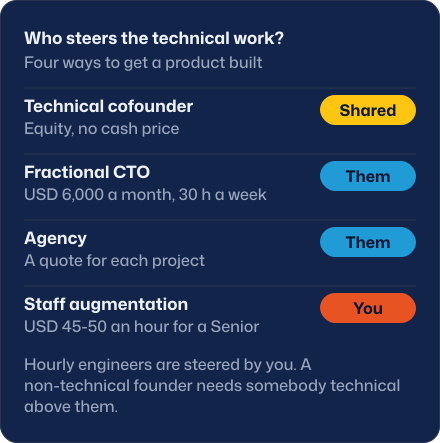
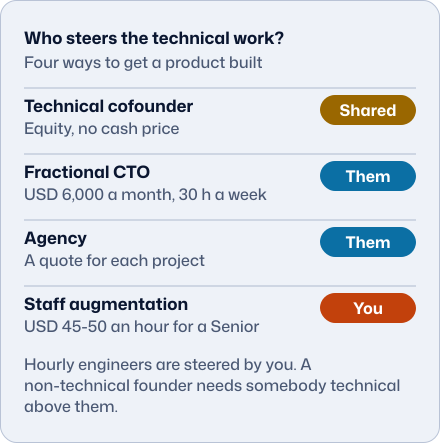
If you are not technical, the question is not which of the four to hire. It is who will steer the engineers. A technical cofounder steers with you. A fractional CTO steers for you. An agency steers inside a scope you sign. Staff augmentation needs you to do the steering. Our prices are public: a fractional CTO is USD 6,000 a month for 30 hours a week, and an engineer is USD 30 to 60 an hour.
We sell two of these four, the fractional CTO and staff augmentation, so discount what I say about them. I’ll say where the other two win.
What does each option cost?
The cost is the easy part. What changes is who decides what gets built, and that is where non-technical founders lose months. Our fractional CTO option has its price and terms published as Fractional CTO.
| Option | What you pay | Who steers | How long it lasts |
|---|---|---|---|
| Technical cofounder | Equity, no cash price | You both | Years |
| Fractional CTO | USD 6,000 a month, 30 h a week | The CTO | 6-month minimum, then 30 days’ notice |
| Agency | A quote for each project | The agency, inside a written scope | One project |
| Staff augmentation | USD 45-50 an hour for a Senior | You | 6-month minimum |
The rates behind the last row are in Nearshore developer rates in 2026, and the fixed-price packages are on the pricing page.
When is a technical cofounder the right answer?
When the product is the company and you will build it for years. Nothing else gets you a person who owns the code the way you own the business, and who is on the hook with you when it breaks.
The cost is permanent. Equity does not come back when it stops working, and the split is a legal and personal decision I won’t put a number on. A test I’d use: would you give this person a share of the company if they had not written a line yet? If you hesitate, don’t. Hire someone for six months and see.
A cofounder search also takes as long as it takes. Meanwhile the product waits. That is the gap the next option fills.
What does a fractional CTO do that a cofounder does not?
A fractional CTO owns the technical direction for a fixed number of hours, without equity. Ours is a senior architect, chosen to fit your company and led by me, for 30 hours a week. The work is the roadmap, architecture decisions, hiring and team review, and a weekly meeting with your leadership. The first two weeks go to understanding the product and the team, then planning and ordering what comes first.
At USD 6,000 for about 130 hours a month (30 a week), that is roughly USD 46 an hour. For scale, the US Bureau of Labor Statistics reports a median wage of USD 175,140 a year for computer and information systems managers in May 2025. Private-industry benefits ran 30% of total compensation in the second quarter of 2026, so that wage becomes about USD 250,000 once benefits are in. Twelve months of fractional CTO is USD 72,000.
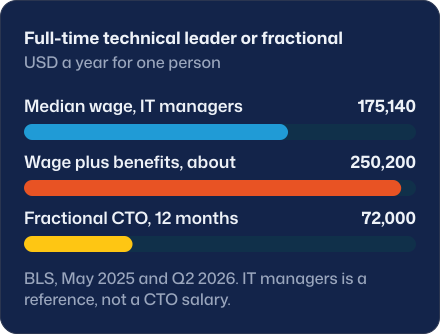
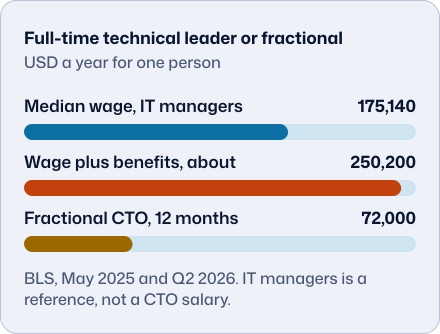
Two cautions. That BLS category is a reference for what an in-house leader starts from, not a CTO salary, and startup CTOs are often paid partly in equity. And 30 hours is not the whole week: a fractional CTO is not the person on call. We work in your business hours and leave alerts and runbooks for your own on-call.
See what the fractional CTO covers and what the first two weeks look like.
When does an agency fit?
When the result is bounded, you can write what “done” means on one page, and you would rather buy an outcome than direct people.
I can’t print agency prices. They are quotes, and I’d be guessing. What I can tell you is what to ask each one. Who owns the code from day one, and who answers when production breaks after delivery? What does acceptance mean in writing, and what does a change request cost?
The trap for a non-technical founder is that you can’t judge the quote. A way out is to buy the thinking before the building. Discovery is USD 7,000 for 1 to 4 weeks and ends with a full roadmap: backlog, roles, critical changes and needs, with daily meetings and progress reviews. You can take that document to any agency, us included, and compare quotes on the same terms.
Is staff augmentation enough on its own?
Only if somebody on your side can direct and review the work. A Senior engineer is USD 45 to 50 an hour, a Lead or Architect USD 55 to 60, billed per hour worked, with a 6-month minimum. You interview the engineer who will do the work, and if that person leaves or doesn’t fit, we replace them and cover the handover at no cost. How it works has the rest, and staff augmentation versus managed services covers who answers when something breaks.
For a non-technical founder, hourly engineers alone put you in the director’s chair. The pairing I’d start from is a fractional CTO for direction and one or two engineers at hourly rates for the work. The first costs about USD 6,000 a month, the second USD 7,200 to 8,000 a month per Senior at 160 hours.
Which one should you pick?
By your situation, not by price:
- No spec and nobody technical, and you are not sure what to build: Discovery first.
- The product is the company and you have a long horizon: look for a cofounder, and don’t stop the product while you look. A fractional CTO can run the first months.
- You need direction and hands, and nobody to direct them: a fractional CTO plus engineers by the hour.
- One bounded result, like a CI/CD pipeline, an internal platform, an AI agent pilot, a test suite or monitoring: a 2-week package at USD 4,000 to 5,000. Choose an agency if the scope is a product rather than a platform.
We build products from nothing, so I’m not arguing from theory. A govtech client portal reached production in 20 days, and the public site of a housing-support service went live in 3 days. Those are durations, not prices: what clients paid is not ours to publish.
What should you do this week?
Write on one page the three technical decisions this product needs in the next 90 days that you can’t make alone. If you can’t name three, your first purchase is Discovery. If you can, bring the page to a call and we’ll tell you which of the four it points to, including when the answer is not us.
Sources
- US Bureau of Labor Statistics, Occupational Employment and Wage Statistics, computer and information systems managers (SOC 11-3021), annual median wage, May 2025, accessed 2026-10-09.
- US Bureau of Labor Statistics, Employer Costs for Employee Compensation, benefits as a share of total compensation, private industry, second quarter 2026, accessed 2026-10-09.
- Our rates and package prices: the pricing page, consulted 2026-10-09.